Article
Operations & money →High-Volume vs. High-Margin NEMT: Choosing the Right Business Model for Your own company
By James O'Donnell, Cofounder and COO, Duet · · Updated
By James O’Donnell, Cofounder & COO at Duet
I wrote this piece to help providers understand the intricate relationship between volume and margin. I'd be glad to help you think through any situation you're facing. Just book a meeting with me!
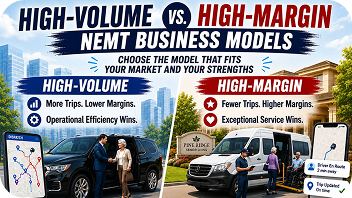
One of the most important decisions you'll make when starting or growing a Non-Emergency Medical Transportation (NEMT) company is whether to pursue a high-volume or high-margin business model.
While there are exceptions, it's difficult to excel at both simultaneously. The operational requirements, customer expectations, pricing strategies, and technology needs are fundamentally different.
The good news? I've seen NEMT providers succeed with both approaches. The key is choosing the model that aligns with your local market, competitive landscape, and personal strengths.
The High-Volume NEMT Model
A high-volume NEMT business relies on large trip counts, efficient operations, and tight cost control to generate profit.
In this model, transportation brokers are typically your primary source of rides. Success comes from accepting a high number of trips, maintaining strong on-time performance, and operating as efficiently as possible.
Characteristics of High-Volume NEMT Operations
- Lower prices and thinner profit margins
- Heavy reliance on transportation brokers
- High percentage of ambulatory trips
- Optimized routing and scheduling
- Strong focus on vehicle utilization
- Limited emphasis on branding and customer experience
If you're pursuing this strategy, becoming a preferred provider for one or more brokers can significantly increase trip volume. However, brokers expect reliability. Consistently returning trips or failing to meet service requirements can quickly damage those relationships.
To maximize profitability, providers often maintain tightly packed schedules and seek opportunities to transport multiple riders simultaneously when permitted. Every additional occupied seat improves revenue without significantly increasing operating costs.
Technology Considerations for High-Volume Providers
Many brokers offer free dispatching software, which can be sufficient for smaller fleets working with a single broker.
However, relying exclusively on one broker creates significant risk.
I've seen transportation companies with more than 20 vehicles lose the majority of their business virtually overnight due to a broker dispute or contract change. Diversification matters.
If you're working with multiple brokers, it's critical to use dispatch software that integrates with all major trip sources. Without integration, dispatchers and drivers often end up juggling multiple apps, creating inefficiencies, missed trips, and poor vehicle utilization.
A common problem occurs when vehicles assigned to different broker platforms drive past each other all day while both have unused capacity. Integrated scheduling and routing software helps eliminate this waste.
Uber and Lyft Integration in NEMT
Many high-volume providers quietly supplement capacity through rideshare partnerships when allowed by contract.
Integrating with rideshare networks can help operators:
- Cover overflow demand
- Handle trips outside their service area
- Reduce rejected trips
- Improve broker relationships
That said, partnering with another local NEMT provider is often a more reliable long-term solution.
Who Is the High-Volume Model Best For?
The high-volume approach is often a strong fit if:
- Your market has brokers with reasonable reimbursement rates
- You excel at operations and logistics
- You can maintain strict cost controls
- You prefer managing systems and processes over sales and relationship-building
In this model, operational efficiency is your competitive advantage.
The High-Margin NEMT Model
The high-margin NEMT strategy takes the opposite approach.
Rather than competing on price, you compete on service quality, reliability, communication, and customer experience.
Higher prices support better vehicles, stronger staffing, and premium service levels.
Characteristics of High-Margin NEMT Operations
- Higher prices and stronger margins
- Significant private-pay revenue
- Strong relationships with healthcare facilities
- Premium customer experience
- Greater emphasis on reputation and branding
- Less dependence on transportation brokers
Primary trip sources often include:
- Private-pay seniors
- Family members arranging transportation
- Assisted living communities
- Skilled nursing facilities
- Independent living communities
- Healthcare facilities
In many cases, facilities may pay directly, bill insurance, or coordinate payment collection from residents and families.
Reputation Is Everything
For premium transportation providers, every trip is a marketing opportunity.
Satisfied riders frequently recommend providers to:
- Family members
- Friends
- Facility staff
- Other residents
- Care coordinators
Conversely, a poor experience can spread just as quickly.
This is why online reviews are so important.
A strong Google Business Profile, positive reviews, and a professional website help justify premium pricing while increasing trust with prospective customers.
Make asking for reviews a standard part of your customer service process.
Building Relationships with Facilities
Facilities can become one of your most valuable referral channels.
Many transportation companies focus exclusively on brokers, while premium providers invest time in building relationships with:
- Executive directors
- Resident care coordinators
- Social workers
- Discharge planners
- Activities directors
When residents consistently report positive experiences, facilities are more likely to recommend your services.
Technology Considerations for Premium NEMT Providers
Private-pay customers and facilities expect a modern experience.
The best technology platforms offer:
- Online scheduling
- Real-time vehicle tracking
- Automated notifications
- Easy trip modifications
- Family access portals
- Facility scheduling portals
Convenience becomes part of the value proposition.
A Different Broker Strategy
High-margin operators typically don't want to become a broker's primary low-cost provider.
Instead, they position themselves as the company brokers call when:
- Service levels matter
- Capacity is limited
- Specialized trips are needed
- Time-sensitive requests arise
This allows providers to accept only trips that meet their profitability targets or help fill otherwise unused schedule gaps.
Who Is the High-Margin Model Best For?
The premium approach may be ideal if:
- Your market has affluent seniors and private-pay demand
- You enjoy relationship-building and networking
- You prioritize customer experience
- You can consistently deliver exceptional service
- Your team excels at communication and professionalism
In this model, reputation is your competitive advantage.
Which NEMT Business Model Is Right for You?
The answer depends on your market, your strengths, and your long-term goals.
If you're highly operational and enjoy optimizing schedules, managing fleets, and controlling costs, the high-volume approach may be the better fit.
If you enjoy building relationships, creating exceptional customer experiences, and developing referral networks, the high-margin model may offer greater opportunities.
Most importantly, avoid trying to be everything to everyone.
The most successful NEMT providers build their entire operation — from staffing and technology to marketing and pricing — around a clearly defined strategy.
Whether you choose volume or margin, consistency is what ultimately drives long-term growth.
About the author
James O'Donnell cofounded Duet and leads its sales, partnerships, and growth services. He talks with NEMT operators every week, hosts the NEMT Growth podcast, and answers Duet's sales line himself. More about Duet's founders →
Want more trips and less busywork?
See how Duet runs and grows NEMT businesses in a 30-minute demo.