Article
How to Start a NEMT Business in Florida (2026)
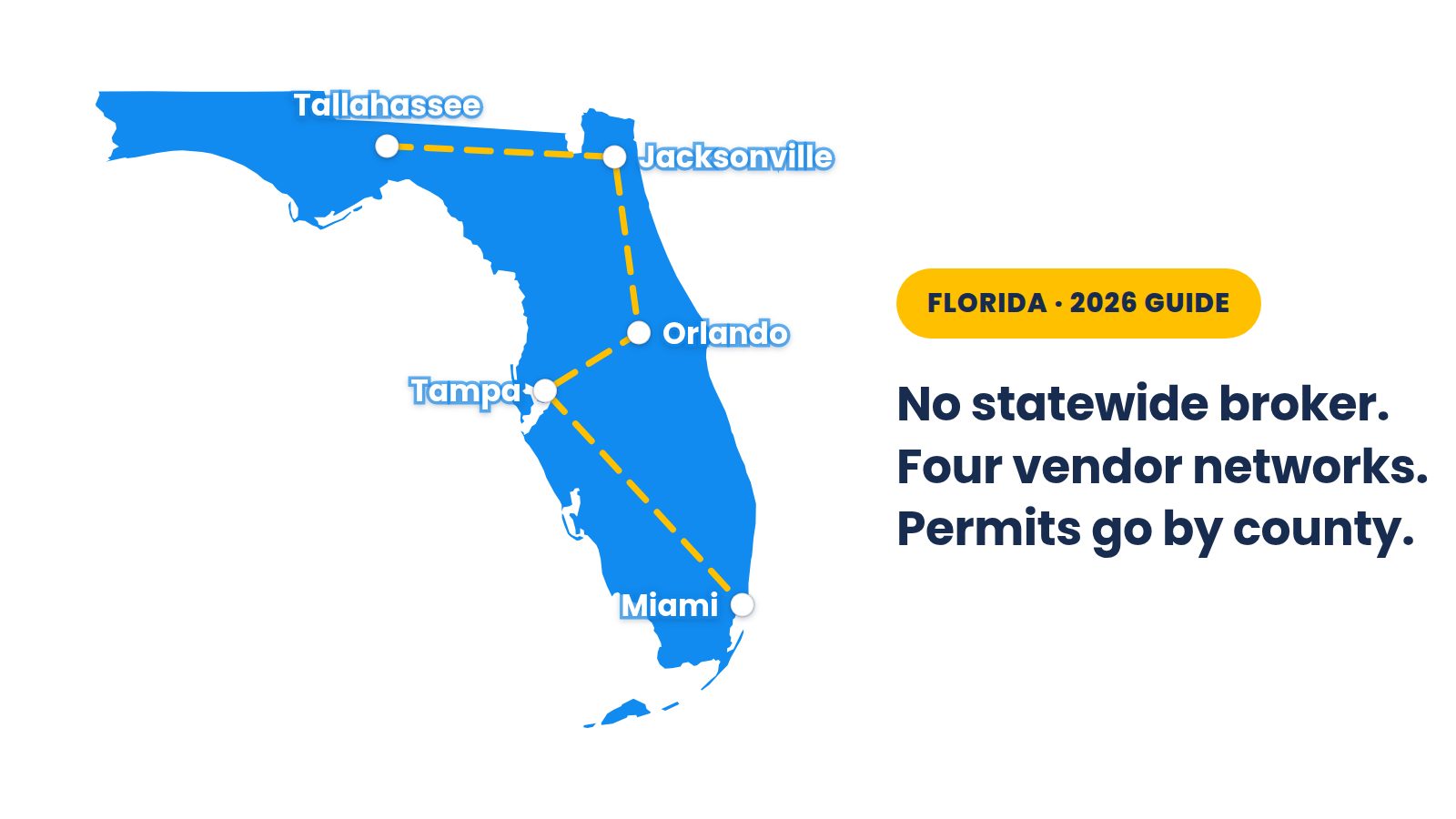
No statewide broker runs Florida's Medicaid rides: each plan hires its own, and the assignments keep changing hands. Here's how to build on that map.
By James O'Donnell, Cofounder and COO, Duet · · Updated
To start a non-emergency medical transportation (NEMT) business in Florida, form an LLC ($125), get your county’s permit where one exists, insure each van and enroll with Florida Medicaid. Florida has no state NEMT license and no statewide broker: you apply to each plan’s broker. One used wheelchair van with six months of fixed bills runs about $22,500 to $50,000 before county permits. Facility and private-pay trips can start once you’re permitted and insured; Medicaid trips take months.
Florida at a glance:
- State NEMT license: none, though on the statutes’ plain words paid passenger vans carry state safety and insurance rules. County permits run from none in Jacksonville to a certificate per van in Miami-Dade.
- Who runs Medicaid rides (October 2026): each health plan’s broker, Alivi, Modivcare, MTM Health or Ride2MD; outside a plan, Modivcare or MTM Health by region.
- First trips: facility and private pay, once you’re permitted and insured.
- How you enroll: usually limited enrollment, the lane for plan network work, 60 days or less once your application is complete, alongside each broker’s own queue.
- Insurance to price: about $1 million of liability, about $1,450 a month for a new company in our national model. The statute’s floor for a paid van reads $100,000 per person and $300,000 per accident for injuries plus $50,000 for property, or $300,000 combined.
- Cost to launch one van: about $22,500 to $50,000, counting six months of fixed bills, before any county permit.
On January 1, 2025, Sunshine Health, the state’s largest Medicaid plan, moved its rides from Modivcare to Alivi [1][2]. Both are brokers, companies a plan or the state hires to assign Medicaid rides to van companies and pay for them. Modivcare spent August 20 to December 29, 2025 in Chapter 11 and kept its trips running [3]. UnitedHealthcare moved its rides to MTM Health on March 1, 2026 [4]. On October 1, 2026, the Children’s Medical Services (CMS) plan moved from Sunshine to Molina, and MTM, which ran the plan’s rides under Sunshine, kept them [5][6]. No van operator got a vote on any of it. In Florida the plan and the broker are separate decisions, made on other people’s calendars.
So the question in Florida isn’t how to sign up with the state’s broker. It’s which plans cover your county, who runs their rides this year, which brokers are taking new companies, and what you’ll run on while each one decides. Build your first schedule on facility and private-pay trips you control, then add each plan’s broker as it lets you in. The checklist comes first, then the questions in the order you’ll hit them.
I run Duet, which builds dispatch software and runs growth services for NEMT companies, and I talk to NEMT owners on demos every week, Florida operators included. This is the Florida edition of our national guide on how to start a NEMT business. Requirements change, so confirm against the linked sources before you spend money.
The one-page checklist: steps to start a NEMT business in Florida
Start a Florida NEMT business in six phases, in the order that wastes the least money: your county and market, the company, federal numbers, the trips you control, then the van and its insurance, then Medicaid and the brokers.
Phase 0: know your demand and your county
- Call your county and city first. Ask whether they license wheelchair and stretcher vans. Miami-Dade wants a certificate for each van, three to six months by the county’s count, so file there in week one [7][8].
- Price a wheelchair trip with five local companies. Search for a wheelchair ride near you, call five companies that come up and ask what the trip costs. Five quotes give you roughly your market’s rate.
- Map your region’s plans. Florida’s nine Medicaid regions, A through I, are set county by county in s. 409.966, Florida Statutes [9].
Phase 1: business foundation
- Form your LLC at Sunbiz, the Florida Division of Corporations site: $125, which is $100 plus $25 for the registered agent, the person or company that takes legal papers for the LLC. The annual report is $138.75 each spring, or $538.75 after May 1 [10].
- Get a free EIN, the federal Employer Identification Number, from the IRS, and the local business tax receipt, Florida’s name for a local business license, from your county and often your city.
Phase 2: federal identifiers
- Get a free Type 2 (organization) NPI, the National Provider Identifier, from the federal NPPES registry, with taxonomy 343900000X, Non-Emergency Medical Transport (VAN).
- Check owners and drivers monthly against the OIG list and SAM.gov, the federal lists of people banned from Medicaid work.
Phase 3: the trips you control
- Line up trips before you buy anything big. A founder getting ready to launch in Tampa told me in August 2026 he had “about 250 facilities to contact” before his van arrived. I told him to “line up the revenue first and then start paying for the insurance and the vehicles.”
- Start facility outreach and private-pay marketing now, with a website that books trips and a Google Business Profile, so trips are waiting once you’re permitted and insured.
- Ask every rider for an honest Google review after each trip. Never trade a free or discounted ride for one: Google’s policy bars offering “discounts, free goods and/or services” for a review, and it counts family ties as a conflict of interest [11].
Phase 4: vehicles, drivers and insurance
- Get three insurance quotes at about $1 million of liability before you pick the van. The premium decides which van you can afford.
- Spec each van to the plan contract. The state’s managed care contract requires lift-equipped vans to meet ADA rules, two-way communications, working air conditioning and heat, and an annual safety inspection [12]. It sets no age cap, but Miami-Dade bars vans older than 15 model years [7], so ask your county and each broker before you buy used.
- Screen owners and principals at Level 2 through the Clearinghouse run by the Agency for Health Care Administration (AHCA), Florida’s Medicaid agency; the statute asks only Level 1 of drivers [13].
Phase 5: Medicaid enrollment and the brokers
- Enroll with Florida Medicaid now through the Florida Medicaid Web Portal, usually through limited enrollment [14][15]. AHCA’s 60-day clock starts at a complete application, and you get 21 days to fix anything missing [16][15].
- Apply to the brokers when you can run their trips. All four brokers have plan members in every region [2]. My rule of thumb is three vans first. Brokers short of vans in your area may sign you sooner [17][18], so lead with what you bring.
Who pays for NEMT rides in Florida?
Five sources pay for NEMT rides in Florida: Medicaid health plans, through their brokers; the state’s fee-for-service lane, which AHCA runs through two brokers of its own; facilities; private-pay families; and the county coordinated system for riders the state calls transportation disadvantaged.
Medicaid is the volume, and in Florida that means the plans
Florida runs the fourth-largest Medicaid program in the country, behind only California, New York and Texas on the federal government’s June 2026 count [19]. The Legislature’s estimating conference put the caseload at 3,947,852 for the year that ended in June 2026 and expects managed care plans, the private health plans the state pays to cover Medicaid members, to hold 73 percent of it in the 2026-27 fiscal year [20].
The current plan contracts, Statewide Medicaid Managed Care 3.0, took effect February 1, 2025 [21], and every plan must cover “transportation to access covered services” under s. 409.973, Florida Statutes [22]. Riders the state doesn’t require to join a plan go through two brokers AHCA hires directly [23].
Facilities are the stability, except dialysis
Hospital discharge desks, skilled nursing, rehab and assisted living: one facility that trusts you can fill a van’s day. Getting in takes relationships. An Orlando owner with two vans told me in June 2026 that skilled nursing facilities there “only use who they know.”
Dialysis is different. Florida has 533 Medicare-certified dialysis facilities, 75 in Miami-Dade, in federal data updated June 2026, and 13 rural counties have none, so in-center dialysis riders there cross a county line for every treatment [24][25]. In my experience most dialysis riders are on Medicaid, though, so those trips come through the brokers, not the clinic.
Private pay is the margin, and it’s seasonal
Florida has more people 65 and older than any state but California, about 5.1 million in the Census Bureau’s 2024 American Community Survey [26]. In Sumter County, home of The Villages, 53.4 percent of residents were 65 or older in the state demographers’ 2023 estimates [27]. As I told a new owner near Ocala on a demo in July 2026, “almost anywhere is going to be doable because there are so many seniors around.”
Demand is seasonal. In the University of Florida’s 2000-2003 household surveys, temporary residents peaked in January and February and bottomed out in August, in a season running roughly November through April, and they skewed older than year-round residents [28]. Plan cash flow for August.
How crowded is it?
Few companies hold an active Florida Medicaid provider ID. Florida Medicaid’s provider master list showed about 295 active provider IDs with the NEMT van code in August 2026, against nearly 3,000 Florida NPIs with that code in the federal registry [29].
The trips you control are another story. “Florida is interesting because there’s a lot of business if you can do good hospital discharge work or take people to hospices and stuff,” I said on our October live episode with Frank Ciccarella, a transportation safety and training consultant, “but it’s quite competitive, too.” Before you plan around discharges, ask whether your hospitals will actually switch providers.
Who is the NEMT broker in Florida?
Nobody holds Florida statewide: each Medicaid health plan hires its own broker, Alivi, Modivcare, MTM Health or Ride2MD [6]. For riders outside a plan, AHCA hires Modivcare and MTM Health by region, under a federal waiver that runs to June 30, 2027 [23]. Our guide to what a NEMT broker does explains how the money flows in every state.
Here’s the map as of October 2026, from AHCA’s third-quarter subcontractor report [6], its September enrollment report [2] and the plans’ own pages [30][4][5]. Confirm before you build on any row. The regions, county by county [9]:
- A: the Panhandle, from Pensacola east through Tallahassee to Madison and Taylor counties.
- B: North and north-central Florida, from Jacksonville and Gainesville to Ocala and Daytona, plus Lake, Sumter, Citrus and Hernando.
- C: Pasco and Pinellas.
- D: Hillsborough, Polk, Manatee, Highlands and Hardee.
- E: Orange, Osceola, Seminole and Brevard.
- F: Southwest Florida, from Sarasota to Collier and inland to DeSoto, Glades and Hendry.
- G: Palm Beach, the Treasure Coast and Okeechobee.
- H: Broward.
- I: Miami-Dade and Monroe.
| Plan | Rides run by | Regions with members |
|---|---|---|
| Sunshine Health, including its Long-Term Care, Child Welfare, Serious Mental Illness and HIV/AIDS plans | Alivi, since January 1, 2025 | A through I |
| Humana | Modivcare | A through I |
| Aetna Better Health of Florida | Modivcare | D, E and I |
| Community Care Plan | Modivcare | E through I |
| UnitedHealthcare Community Plan | MTM Health, since March 1, 2026 | B, D and I |
| Simply Healthcare, including Clear Health Alliance | Ride2MD | A through I |
| Florida Community Care | Ride2MD | A through I |
| Molina Healthcare of Florida (Medicaid plan) | MTM Health | I |
| CMS Plan by Molina Healthcare | MTM Health; Molina has run the plan since October 1, 2026 | A through I |
| No plan (fee-for-service) | Modivcare in Regions A, G, H and I; MTM Health in B through F | A through I |
How does a Florida Medicaid ride reach your van?
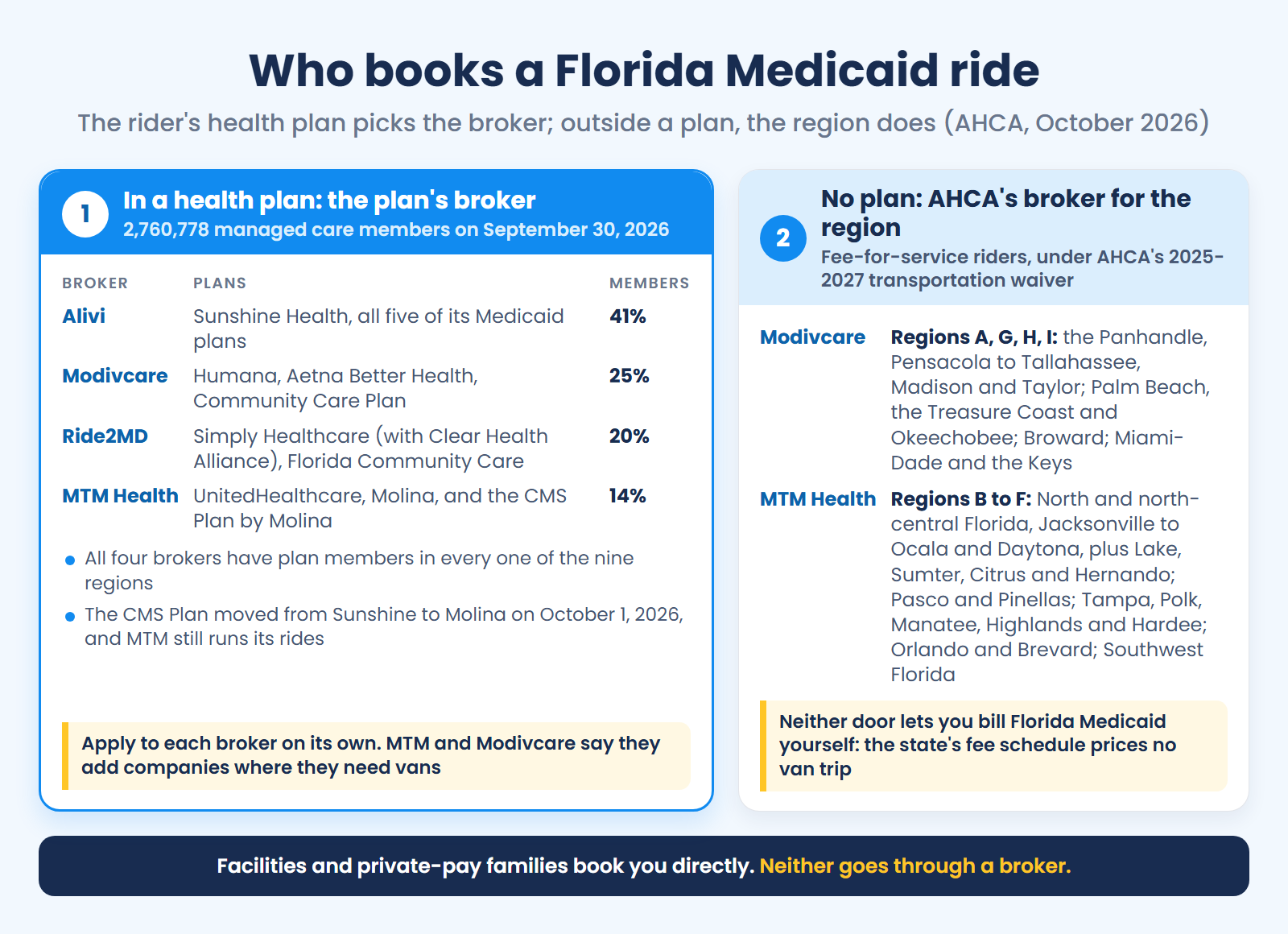
A Florida Medicaid ride reaches your van through one of two doors: a plan member books with the plan’s broker, and a rider outside a plan books with AHCA’s broker for the region. Apply to each broker on its own. Neither door lets you bill Florida Medicaid yourself, and facilities and private-pay families book you directly.
Which broker has the most plan members?
Alivi, through Sunshine Health, has the most. AHCA’s enrollment report counted 2,760,778 managed care members on September 30, 2026 [2]. By broker:
- Alivi: 1,129,971, or 40.9 percent, all of them Sunshine Health members, across its five Medicaid products [30][1].
- Modivcare: 690,995, or 25.0 percent: Humana, Aetna Better Health and Community Care Plan [31][32], plus fee-for-service rides in Regions A, G, H and I [23].
- Ride2MD: 553,340, or 20.0 percent: Simply Healthcare, including Clear Health Alliance, and Florida Community Care [33][34].
- MTM Health: 386,472, or 14.0 percent: UnitedHealthcare [4], Molina’s Medicaid plan in Miami-Dade and Monroe [35] and the CMS plan [5], plus fee-for-service rides in Regions B through F [23].
Members are people, not trips, and the counts don’t say who’s short of vans.
October 1: a new plan, the same broker
The CMS Plan, about 107,000 Medicaid members under 21 with special health care needs, moved from Sunshine to Molina Healthcare on October 1, 2026 [5][2]. The plan changed and the broker didn’t: MTM ran its rides under Sunshine and runs them under Molina [5][6]. Sunshine’s provider contracts didn’t transfer [36], but for a van company the door is still MTM’s. It’s the story our national broker tracker tells state by state: the trips never disappear, they change hands. In Florida they change hands plan by plan, so check the broker plan by plan.
Why does MTM’s Florida page say regions 3 through 8?
MTM still describes its fee-for-service territory by the old numbers, regions 3 through 8 [37], from before the 2025 contracts. AHCA’s January 2025 slides fold old Regions 1 and 2 into Region A and 3 and 4 into B [21], and AHCA’s waiver gives MTM Regions B through F [23]: the same territory under today’s letters. Check the date on any broker list you find, including the state’s.
Can I bill Florida Medicaid directly for NEMT?
In practice, no, not for van work: Florida’s Medicaid fee schedule prices only ambulances, so a wheelchair or stretcher van trip pays whatever your broker contract says.
No state rate exists for van work
Florida’s Transportation Services Fee Schedule, dated January 1, 2026, prices only ambulance work, with the same non-emergency rates as the 2025 schedule [38]. Non-emergency basic life support (BLS) ambulance pays $137.96 and advanced life support (ALS) $192.73; the rest is emergency and air ambulance codes and an “as negotiated” line. There’s no wheelchair van rate, no stretcher van rate, no ambulatory rate and no ground mileage code, so any “Florida Medicaid wheelchair rate” you read didn’t come from the state’s fee schedule [38].
Your contract is the rate
Florida Medicaid calls NEMT rides non-emergency transportation (NET), and its coverage policy says the non-ambulance ones “are reimbursed at a mutually agreed upon negotiated rate between the transportation broker contracted with AHCA and the provider” [39]. Sunshine tells providers to bill its broker, not the plan [30]. Your rates get set when you negotiate the contract, so know your cost per trip before you sign one, and ask to renegotiate the rate sheet every year.
A rate sheet sets the base rate, the loaded-mile rate (miles with a rider aboard), no-show and cancellation terms and any after-hours or stretcher pay. Don’t count on pay for waiting: Florida’s coverage policy lists “Time spent waiting on a recipient to receive a service” among the things Medicaid doesn’t cover [39]. Get the wait and no-show terms in writing before you sign.
You still need the state enrollment
For Medicaid trips, skipping the state enrollment voids everything else. The state’s managed care contract makes every plan check that its providers hold a current Medicaid provider agreement [12]. Sunshine’s August 2024 notice to providers lists the denial codes for claims from providers whose Medicaid ID isn’t active on AHCA’s provider master list [15].
What is Florida’s Transportation Disadvantaged program, and do I have to join it?
You don’t have to join Florida’s Transportation Disadvantaged program: the coordinated transportation system binds the agencies that spend transportation-disadvantaged money, not private van companies. Under Chapter 427, Florida Statutes, a state commission designates a Community Transportation Coordinator (CTC) for each county, and that money has to be spent through the system [40][41]. Forty-five coordinators serve the 67 counties [25]. The Commission’s report says purchasing agencies’ programs, Medicaid managed care among them, “fall outside the Commission’s direct regulatory authority” [41]. Take plan work, though, and the system’s rules come along: the state’s plan contract makes plans hold their transportation companies, rideshare networks aside, to the standards in Chapter 427 and Rules 41-2 and 14-90 [12].
For you, the coordinated system is an optional fifth revenue lane:
- CTCs must subcontract where it’s cheaper. Under s. 427.015(2), a coordinator “shall subcontract or broker those services that are more cost-effectively and efficiently provided by subcontracting or brokering,” and private for-profit companies count as transportation operators by definition [40].
- The money is real. In fiscal 2024-25, the latest year reported, the system moved 14.4 million trips on $427.6 million of revenue, about $52.9 million of it from the Commission’s Trip and Equipment Grant. Its 57 transportation operators, the companies coordinators subcontract to, ran about 31 percent of those trips [41][25].
- You get paid on a clock. Rule 41-2.006 has the coordinator pay subcontractors within 7 working days of being paid itself, and sets an insurance floor of $200,000 per person and $300,000 per incident [42].
- Find your coordinator in the Commission’s annual operating report. Most are county governments, nonprofits or transit agencies; two are for-profit companies, MV Transportation in Alachua County and MTM Transit, LLC in DeSoto, Hardee, Highlands and Okeechobee [25].
- Orlando exempts the work. Trips under a CTC contract on file with the city, in vehicles marked for the program, are exempt from Orlando’s vehicle-for-hire rules [43].
One phone call tells you whether your county’s coordinator subcontracts wheelchair trips.
What licenses and requirements does a NEMT business need in Florida?
Florida has no state NEMT license: on the plain words of s. 316.003, Florida Statutes, a van that carries riders for pay is a “nonpublic sector bus,” with safety rules and an insurance floor, and the county is where permits bite [44][45]. The state’s ambulance law licenses only advanced and basic life support services [46], and Florida issues no state permit for vehicles for hire; counties and cities license them [47].
The state layer: safety rules and an insurance floor, not a license
- On the statute’s plain words, paid passenger vans are “nonpublic sector buses.” Florida law calls any vehicle “other than a taxicab, designed and used for the transportation of persons for compensation” a bus. Section 316.70 puts privately run ones under the federal motor carrier safety rules, which cover driver qualification, hours of service and vehicle maintenance, among other things, and s. 316.302’s 26,001-pound relief “does not apply to any nonpublic sector bus” [44].
- What that means for a minivan isn’t settled. The federal rules define the vehicles they cover by size: built or used to carry more than 8 passengers for pay, counting the driver, or rated at 10,001 pounds and up [48]. A van that seats eight or fewer, counting the driver, and is rated under 10,001 pounds sits under both lines, and no Florida agency text says how s. 316.70 treats it. The Florida Highway Patrol (FHP) says companies running commercial motor vehicles must register for a USDOT number, with no fee for companies that operate only inside Florida and fees possible for interstate ones [49]. So before you buy, ask FHP’s commercial vehicle office two questions: do the safety rules reach your van, and does it need a USDOT number? Mention any trips across the state line when you call.
- Reciprocity skips NEMT. Since 2024, a vehicle-for-hire permit from your home county or city works in the others, but s. 320.0603(4) leaves out riders on stretchers or in wheelchairs and riders a regular common carrier can’t practically take [50]. NEMT still permits county by county.
The county layer: where Florida bites
Counties can license vehicles for hire in their unincorporated areas under s. 125.01(1)(n) [47], and several license wheelchair and stretcher companies through their emergency medical services codes instead. The biggest programs, as of October 2026:
| County or city | What it requires | Fees, one van and one driver | Clock and inspections |
|---|---|---|---|
| Miami-Dade | A certificate per van, a chauffeur registration per driver | $300 application, $25 background check, $625 a year, $55 per driver, $70 first inspection [51][7] | Three to six months, then 90 days to insure and inspect; quarterly inspections from 5 model years; nothing older than 15 [8][7] |
| Broward | A service license, a permit per van, a chauffeur registration per driver | $741 application, $369 license, $75 per van, $135 per driver for two years [52] | Ask the Consumer Protection Division |
| Hillsborough | A certificate from the Tax Collector, a permit per van (“handicab”), a public vehicle driver’s license per driver | $300 certificate, $150 per van, $65 driver badge [53] | No published approval time; a yearly inspection by an ASE-certified mechanic (Automotive Service Excellence) or a state-licensed repair shop, plus an extra check past 10 model years [54] |
| Palm Beach | A vehicle-for-hire business permit, with at least two vans | $10,000 new-business fee on the 2020 form, plus $100 and $50 per van [55] | A yearly ASE mechanic’s inspection and a yearly county visual check [56] |
| Pinellas | A certificate of public convenience and necessity (COPCN) from the county commission, sitting as the EMS Authority | Ask the county | Commission approval; the providers on the county’s posted list hold certificates the commission approved July 22, 2025 [57][58] |
| Orange County | A license and a permit per van, through the county’s EMS division | Set by the county commission | A decision within 60 days; each van inspected [59] |
| City of Orlando | Vehicle and driver permits from the police department | $250 application, $200 per van [43] | Ask the unit, 407-246-2855 |
Osceola, Sarasota and Alachua license NEMT companies too: Osceola by permit after a public hearing, Sarasota through its county health department within 30 days, and Alachua by certificate after existing operators get 30 days to protest [60]. Jacksonville issues no city permit, but its code has the company background-check drivers every three years and file a CPA’s compliance report every other year [61]. Lee and Polk exempt non-emergency stretcher vans from their ambulance certificates [60].
Two items need a phone call. Miami-Dade’s page still describes a commission vote, but its code, as amended in 2021, gives the decision to the department’s director [8][7]. Palm Beach’s $10,000 comes from its 2020 form; confirm it with Consumer Affairs at 561-712-6600 [55]. Budget a week of phone calls to your county and city before you buy anything; it’s the cheapest insurance in this guide.
Ten claims you’ll read elsewhere, and what Florida actually requires
Much of what circulates about Florida is wrong, starting with the NEMT licenses that don’t exist:
| The claim you’ll read elsewhere | What Florida actually requires |
|---|---|
| A “Florida NEMT Provider License” (“$850 initial, $510 renewal”), “NEMT provider certification” or a statewide certificate | None exists. AHCA enrollment is Medicaid paperwork, the Department of Health licenses only life support services, and NEMT certificates come from counties [46][62][7] |
| “The two dominant NEMT brokers in Florida are MTM Health and ModivCare,” or contract with “Access2Care” | Four brokers hold the plans: Alivi, Modivcare, MTM Health and Ride2MD. Access2Care is part of MTM, and LogistiCare is Modivcare’s old name [6][63] |
| Sunshine Health’s rides run through ModivCare, and Simply’s too | Alivi has run Sunshine’s rides since January 1, 2025; Ride2MD runs Simply’s [1][33] |
| Florida requires “General liability ($100,000)” and 25/50/25 auto coverage | No Florida statute, rule or Medicaid policy says so. The statute’s floor for a paid van reads 100/300/50 or $300,000 combined [45] |
| “You can contract directly with Medicaid” and skip the brokers | Not for van work. Van trips go through brokers, each plan’s or AHCA’s two [38][39] |
| Vehicles must “pass Florida’s required safety inspections” | No state inspection program exists, but the state’s plan contract requires an annual safety inspection [12] |
| Insurance “a minimum of $300,000 to $1,000,000,” or $1 million just to enroll | Enrollment asks for proof of $100,000/$200,000 [15], less than the statute’s floor as it reads [45]. The $1 million is what hospitals, facilities and many brokers ask |
| A “$350 non-refundable AHCA enrollment fee” | Florida’s February 2026 enrollment policy lists no application fee for transportation providers [15] |
| “AHCA requires Level 2 background screening for all NEMT drivers serving Medicaid clients,” plus a chauffeur license or a CDL | Drivers need Level 1 by statute, owners Level 2. Florida has no chauffeur license, and a typical van needs no CDL [13][64] |
| Florida Medicaid pays about $25 per ambulatory trip, $45 for wheelchair, $100 for stretcher, or “$25-$100 per hour” for waits | No Florida document says so. The fee schedule prices only ambulances, and waiting time isn’t covered [38][39] |
What are the NEMT insurance requirements in Florida?
Price about $1 million of liability before you buy the van: hospitals and facilities ask for it, and so do many brokers. Tony Jackson, an Orlando operator, said in our October 2025 episode about facility contracts that facility work in Florida takes “a million dollar coverage”: $1 million per incident and $2 million aggregate. On the broker side, as I said on that October live episode, a lot of brokers require $1 million. The brokers’ own pages don’t settle it: Modivcare says its insurance limits “vary by state,” and MTM’s and Alivi’s provider pages print no dollar figure [18][17][65]. So ask each broker for its number in writing.
What Florida’s statute requires, for the record
On the statute’s plain words, a van carrying riders for pay is a nonpublic sector bus, and s. 627.742 says each one “must carry” $100,000/$300,000/$50,000 of liability, written 100/300/50, or a $300,000 combined policy [45][44]. Florida’s financial responsibility law points those buses to the same amounts, and personal injury protection (PIP) applies on top [66][45]. Confirm with your agent. If you’ve read that Florida’s floor is $10,000, that’s the private-car rule: $10,000 of PIP and $10,000 of property damage liability, with bodily injury liability “generally not required” [67].
Which insurance minimums apply to a Florida van?
Several bars can apply at once, so carry enough to clear every one that reaches your work, limit by limit. Enrollment asks for the least, proof of $100,000/$200,000, and hospitals, facilities and many brokers ask the most:
| Who sets the bar | The number |
|---|---|
| Florida statute, as its words read, for a van carrying riders for pay | $100,000/$300,000/$50,000 or $300,000 combined, plus PIP [45] |
| Florida Medicaid enrollment | Proof of $100,000 per person and $200,000 per incident [15] |
| The state’s plan contract and the coordinated system, for transportation-disadvantaged trips | $200,000 per person and $300,000 per incident [12][42] |
| Counties | Miami-Dade, Osceola and Sarasota 100/300/50; Hillsborough and Palm Beach 125/250/50; Broward $500,000 combined per van [7][52][53][56][60] |
| Hospitals, facilities and many brokers | About $1 million of liability; facility contracts can ask $2 million aggregate |
The plan contract sets its $200,000/$300,000 for transportation “for the transportation disadvantaged through the Managed Care Plan” [12], so ask your broker whether it reads that as every plan trip.
What it costs a new company
Budget about $17,400 a year for a new company’s wheelchair van at about $1 million of liability. That’s what our national startup cost model uses, from new-company quotes and estimates of $1,200 to $1,800 a month: about $1,450 a month, with roughly a quarter, $4,350, due at signing and ten payments of $1,305 after.
Florida runs high. A new one-van owner east of Orlando told me on a demo in July 2026 that broker-level cover, a million in liability and a million in commercial auto, was quoted at $3,000 to $4,000 a month. He bought “the very bare minimum to start,” about $800 a month, and dropped the broker route. “Florida insurance tends to be higher than almost any other state,” I told him, and with one van it’s “not worth it to buy those million-dollar insurance plans just to work with the broker.” His is one quote, not a Florida price, and a bare-minimum policy works only where the statute’s floor and your county’s rules allow it.
Workers’ comp arrives at your fourth employee
Florida requires workers’ compensation for non-construction businesses with four or more employees, full or part time, and an officer who has filed an exemption doesn’t count toward the four. Up to 10 LLC members who each own at least 10 percent can file exemptions [68]. So a two-founder LLC with two drivers sits right on the line until the founders file theirs. Decide that before you hire the second driver.
What do NEMT drivers need in Florida?
NEMT drivers in Florida need a regular Class E license for a typical wheelchair van, not a CDL or a chauffeur license, plus a Level 1 background screen under the Medicaid statute and whatever the broker file and your county add [64][13].
No CDL for a wheelchair van
A commercial license starts at 26,001 pounds, or a vehicle designed for more than 15 people including the driver, under s. 322.01, Florida Statutes, and an ordinary Class E license covers everything below that. Florida issues Classes A, B, C and E only: no state chauffeur license and no Class D, whatever a template guide tells you [64]. The chauffeur registrations Miami-Dade and Broward require are county rules.
Level 2 for owners, Level 1 for drivers
Owners, officers and anyone with 5 percent or more of a Medicaid-enrolled company need Level 2 fingerprint screening through AHCA’s Care Provider Background Screening Clearinghouse, under s. 409.907 [13].
Drivers are different. The same statute carves them out: “Nonemergency transportation drivers who are employed or contracted with transportation companies, transportation network companies, or transportation brokers are not subject to a level 2 background screening but must comply with a level 1 background screening” [13]. An equivalent screen AHCA accepts also counts [69][39]. Level 1 is a name-based check: employment history, a statewide criminal records check through the Florida Department of Law Enforcement and the national sex offender website [13]. So “every driver needs Level 2” is wrong as state law, and so is skipping screening.
Level 2 fingerprints cost $60 through the Clearinghouse plus the fingerprint vendor’s fee, prints stay on file for five years, and the Clearinghouse says the full process “typically takes 5 to 7 business days” [70].
What do brokers and counties add to the driver file?
What your drivers need day to day comes from four places:
- The broker file. Modivcare lists a PASS wheelchair certificate, which it describes as completing hands-on wheelchair transport training, plus first aid and CPR, defensive driving, a drug screen, a clean driving record and a background check [18]. MTM adds fraud, waste and abuse training and HIPAA training for every employee every year [17].
- The plan contract. The Chapter 427 and Rule 41-2 and 14-90 standards that plans pass down cover “drug and alcohol testing, safety standards, driver accountability, and driver conduct” [12].
- Your county. Miami-Dade’s chauffeur registration is $55 a year [51], and Broward’s is $135 for two years, fingerprints included [52]. Hillsborough wants a public vehicle driver’s license for every for-hire driver, with Level II fingerprints, and handicab drivers need first aid, CPR and defensive driving within 30 days [54].
- The escort and children rules, worth writing into your driver handbook. Florida Medicaid requires you to carry an eligible rider’s escort free, and the escort can’t be the driver or one of your employees [39]. Managed Medical Assistance plans must also carry up to three of a rider’s dependent children under 13 at no extra cost [12].
Can a NEMT company run stretcher van trips in Florida?
Yes, Florida allows stretcher van trips for riders who don’t need and aren’t likely to need medical attention on the way, but the moment your crew does anything clinical, including adjusting oxygen, it’s an ambulance trip. Florida’s ambulance law, s. 401.23, defines an ambulance as a vehicle for people “requiring or likely to require medical attention during transport,” and requires a state license plus a county certificate only for advanced and basic life support services [46]. The test looks ahead: a rider likely to need care on the way is an ambulance call before anything happens.
Florida Medicaid lists “medical vehicles (wheelchair or stretcher vans)” as their own provider category, separate from ambulances [39]. The Department of Health licenses only life support services: 346 EMS providers on its October 2026 roster, just eight of them basic life support [62]. A stretcher van for riders who need no care on the way sits outside that license [46].
The department’s own FAQ draws the oxygen line [71]:
- Checking vital signs, or “starting, stopping, or in any way altering the flow of oxygen,” is basic life support, which a company can’t offer without an EMS license.
- So is offering riders oxygen or helping them use it, because oxygen is a prescription drug.
- If riders bring their own prescribed oxygen and run it themselves while your crew only loads and unloads it, “you do not appear to need an EMS license.”
Put that line in your dispatch protocols in writing. The licensing statute also reaches anyone who advertises life support transportation, so market stretcher work as transportation, never as care [46]. Miami-Dade requires every ad to say the service provides no medical attention [7].
The county layer hits stretcher work hardest. Miami-Dade, Broward and Orange County license stretcher vans [7][52][59]. Pinellas certificates even non-medical stretcher vans and makes it a violation to use an uncertificated one, which reaches the facilities and brokers that book you [57]. Alachua defines an ambulance to include a vehicle for people “who must be transported on a stretcher,” and Sarasota lets riders bring their own oxygen only if they can self-administer it, with no more than 500 liters on board [60]. Hillsborough wants two attendants with public vehicle driver’s licenses on every stretcher handicab [54].
Train for the work, too. A first-year owner said in a 2025 podcast interview that stretcher trainers “are hard to find in Florida,” so line up a class before you buy the stretcher.
How do you become a Florida Medicaid NEMT provider and get broker work?
Run two tracks: enroll with Florida Medicaid now, which AHCA says takes 60 days or less once your application is complete [16], and apply to each broker whose plans cover your counties once you can run their trips.
Track one: the state enrollment
Florida Medicaid enrollment runs through the online wizard at the Florida Medicaid Web Portal, which issues a nine-digit provider number when you’re approved [14]. Transportation is provider type 41, with two lanes: full enrollment, for providers who bill Florida Medicaid’s fee-for-service program directly, and limited enrollment, for managed care network work, the lane most startups need [15]. Since the state’s fee schedule pays no van trip [38], fee-for-service van rides still go through AHCA’s two brokers [23][39]; if you’ll run them, ask the broker which lane it wants.
What the application wants [15]:
- Your company paperwork, including your local license or business tax receipt where your county or city requires one.
- Proof of liability insurance at $100,000 per person and $200,000 per incident.
- Fingerprints for Level 2 screening from everyone named on the application.
- An AHCA Medicaid provider surety bond (Form 5000-1064), a guarantee you buy from a bonding company. The policy lists it for non-emergency transportation and waives it “if contracted through the transportation coordinator.” By statute, AHCA sets a new provider’s bond from the provider’s own estimate of its first year’s billing [13]. Ask AHCA whether the bond applies to a limited enrollment and which contracts count for the waiver.
- No site visit, usually. Non-emergency transportation sits in the limited screening risk category, so there’s no required pre-enrollment site visit, though AHCA can visit any provider.
AHCA’s enrollment page says “Processing is 60 days or less from the date your complete application is received” [16]. “Complete” is the word that matters: the state tells you in writing if anything’s missing, and you get 21 days to fix it or start over [15]. Once approved, your enrollment counts from the date the state received your application [13]. Meanwhile, the state’s plan contract lets a plan sign you while your enrollment is pending for up to 60 days, and makes it drop you if the enrollment doesn’t come through [12]. That window is written for the plans, so ask each broker whether it will credential you while your enrollment is pending.
Track two: the brokers
Every broker is its own application, its own requirements packet and its own unpublished queue. What each publishes about joining, as of October 2026 [17][18][65]:
| Broker | What it publishes about joining |
|---|---|
| MTM Health | ”If we don’t have an immediate need in your area, we’ll keep your information on file and reach out when we have opportunities for you.” Six steps, from application to first trip. No timeline |
| Modivcare | A map of the “priority areas where we urgently need support,” plus driver and vehicle requirements. No timeline |
| Alivi | A web interest form asking your counties, NPI, driver and vehicle counts, levels of service and dispatch platform. No published requirements or timeline |
| Ride2MD | Ask Simply Healthcare’s or Florida Community Care’s provider services for Ride2MD’s network contact |
What to run on while the queues move
Run on facility and private-pay trips while the queues move; our guides on winning facility contracts, getting your first trip from a facility meeting and private pay are the playbook for those months. Brokers can’t be the plan, because most Florida startups hit the same catch-22: brokers add companies where they’re short on vans and like a track record, which you can’t build on trips they haven’t given you. The new owner near Ocala was still “waiting to get my Medicaid number” when we talked, running private pay in the meantime. A Tampa-area owner said in a January 2026 podcast interview that the broker onboarding forms he found online went unanswered while his new vans sat parked. When Alivi did take him on, it gave him “a little bit at first” and more as he performed.
I’d wait for the third van, and for enough time in business that a broker sees a real service that won’t be gone in three months. Here’s the other side, though. Brokers do sign new companies where they’re short, and a Broward owner with five vehicles told me in July 2026 that Alivi is “one broker that I’m consistent to get work from.” If you bring what’s scarce in your area, say so in the application.
Don’t build the whole schedule on one payer
In Florida a broker’s volume is borrowed plan by plan, as the handoffs since January 2025 show, so line up a second payer, a facility account or a private-pay channel, before you sign your first broker contract.
Every handoff at the top of this guide happened on someone else’s calendar, and more can come: Community Care Plan put its own ride contract out to bid in March 2026, and its July 2026 handbook still names Modivcare [72][32].
Running only broker trips works, as I told an owner launching two vans in September 2026, right up until the broker loses the contract and the new one doesn’t want to work with you. Marqus Johnson, a Tampa operator and coach, said it plainly in his July 2026 episode on drivers who sell: “If you allow a broker to send you as many trips as humanly possible, they’re happy to do so. And as long as you complete them, they could care less.” Volume isn’t loyalty. None of this makes brokers villains. “Brokers serve a purpose,” Marqus said on the same episode, and he still tells new owners to start with private pay.
Facility contracts carry their own Florida upside. Tony Jackson writes a hurricane evacuation agreement into his facility contracts, because facilities and hospitals like to see one. In his telling, for one evacuation his company charged $1,000 for every wheelchair rider and $2,000 for every stretcher rider, a 300 percent upcharge for sending drivers out in a hurricane. Because it was an emergency evacuation, he said, the state, not the facility, paid within 60 days.
Florida makes spreading the risk easier than a single-broker state does. You have four brokers, each holding different plans; 45 community transportation coordinators, 28 of which subcontract some or all of their trips [25]; and the facilities and private-pay families in your county. Spread your trips across two or three of those, and no single contract change can zero your schedule.
For comparison, Georgia has exactly one broker door. California has a door for every plan and a state lane only about 5 percent of members use. North Carolina pairs two broker doors with a county fee-for-service lane.
Then run every lane from one schedule. Dispatch software like Duet runs Alivi, Modivcare and MTM trips on one board with the rides you book yourself. Modivcare and MTM are direct integrations, which covers Humana, Aetna, Community Care Plan, UnitedHealthcare, Molina’s two plans and both fee-for-service lanes. Alivi’s trips come in by trip file import, any other trip list by import or bulk upload, and each trip bills at the rate its contract sets. Your county permits, each broker’s credentialing and rates, and invoicing each payer through its own process stay with you.
How much does it cost to start a NEMT business in Florida?
Budget about $22,500 to $50,000 for one used wheelchair van in Florida, counting six months of fixed bills, before any county permit. Those totals are cash out the door through month six, so a financed van counts as its down payment plus six payments.
The middle case is a 2016-2019 van at our national model’s $33,000, financed with 20 percent down. Florida’s own inputs are its fees and taxes; fuel and your own living costs aren’t in the totals.
| Line item | Florida amount | Note |
|---|---|---|
| LLC formation | $125 | $100 filing plus $25 registered agent; the annual report is $138.75 each spring [10] |
| EIN, NPI and state NEMT license | $0 | No state NEMT license exists [46] |
| Medicaid enrollment fee | $0 | Florida’s policy lists none for transportation providers; confirm with AHCA [15] |
| Medicaid surety bond | The premium, if required | Listed for non-emergency transportation, waived “if contracted through the transportation coordinator”; not in the totals [15][13] |
| Owner’s Level 2 screening | About $85 to $145 | $60 to the Clearinghouse plus the fingerprint vendor’s fee [70] |
| Used wheelchair van, 2016-2019 | About $33,000, or $6,600 down | National model: 80 percent financed at 14 percent over 60 months, $614 a month; older high-mileage conversions list for $15,000 to $25,000 |
| Sales tax, title and plate | About $2,200 | 6 percent of the price plus your county’s surtax on the first $5,000, a $56.25 for-hire title and a plate of about $124 [73][74] |
| Insurance due at signing | About $4,350 | A quarter of the national model’s $17,400 year |
| Equipment, training and marketing | About $2,300 | National model: $1,000 for equipment and lettering, $1,000 for your own screening and training as the first driver, $300 for a phone and basic marketing |
| County permits | $0 to about $10,200 | $0 where no county permit exists, as in Jacksonville; about $1,100 for one van’s first year in Miami-Dade, about $1,300 in Broward, $515 plus inspection and fingerprint fees in Hillsborough; $10,200 on Palm Beach’s 2020 form, which also wants two vans; not in the totals [61][51][7][52][53][55] |
| Six months of fixed bills | About $11,600 financed, $7,920 paid off | $1,934 a month financed: a $1,305 insurance installment, a $614 van payment and $15 for a phone |
| Total, owner driving | About $27,300 financed, $50,000 paid off | An older $20,000 van, financed, comes to about $22,500 |
Anyone quoting a $5,000 Florida launch hasn’t priced Florida commercial auto. Price your own insurance quote in before you commit: at $3,000 a month, the low end of the one-van owner’s quote in the insurance section, the same range runs about $35,500 to $63,100.
The revenue numbers you’ll see online
You’ll see “$250,000 to $500,000 per vehicle per year” in AI-written guides, and Google’s answer box sometimes repeats it. Run the arithmetic. $250,000 a year is about $21,000 a month. A realistic solo-run van does roughly 100 trip legs a month (a leg is one one-way ride), and even a maxed-out dialysis route caps around 250. So the projection needs somewhere between $83 and $208 from every single leg, all year. No Florida broker contract pays that.
What a van really grosses depends on your payer mix, with private pay carrying the margin. Build the model on legs per day times your blended rate, the average across all the payers you carry, not on a number invented to sell a course.
How do you fund a NEMT startup in Florida?
If savings don’t cover your NEMT startup costs, start with SBA loans and the Florida SBDC Network’s no-cost consulting:
- SBA 7(a) loans and microloans. Microloans go up to $50,000 and average about $13,000, and 7(a) loans can pay for working capital and equipment [75].
- The Florida SBDC Network offers no-cost consulting from more than 40 offices statewide [76].
- Two programs that are gone. Florida repealed its Microfinance Loan Program in 2023 and moved Enterprise Florida’s duties to the Department of Commerce, now FloridaCommerce, the same year [77]. Guides still routing you to either are out of date.
- The Microfinance Guarantee Program survives in statute and backs loans of $50,000 to $250,000 for small borrowers [78]. Confirm it’s actively guaranteeing with FloridaCommerce before you count on it.
None of this speeds up a county certificate or a broker queue, so borrow against the timeline you actually face.
How long does it take to start a NEMT business in Florida?
Months, not weeks. Expect a few weeks of paperwork, up to 60 days at AHCA once your application is complete, and a broker queue no broker puts a clock on [16]. In Miami-Dade, each van’s certificate takes three to six months by the county’s own count [8]. Other counties publish shorter clocks: Orange County’s commission decides within 60 days, and Sarasota’s health department within 30 [59][60]. In Miami-Dade, approval starts one more clock, 90 days to finish your insurance and inspections or the approval lapses [7].
The brokers are the clock nobody can give you: MTM, Modivcare and Alivi publish no timeline [17][18][65]. A realistic sequence:
- Weeks 1-2. LLC ($125), EIN, NPI and the local business tax receipt. Call your county and city about wheelchair and stretcher permits, map your region’s plans and price a trip with five local companies. In Miami-Dade, file the certificate application now. Start the website, the Google Business Profile and the facility visits.
- Weeks 2-6. Insurance quotes at about $1 million from an agent who writes NEMT, then the van, once you know the premium. Owners’ Level 2 screening, about 5 to 7 business days. Driver files and county driver registrations where required. Submit the Florida Medicaid enrollment.
- From the day you’re permitted and insured. Your first facility and private-pay trips, and a private-pay rate card. Call your county’s coordinator about subcontracting. This revenue doesn’t wait on a broker deciding it needs you.
- Within 60 days of a complete application. AHCA decides on your enrollment; if anything’s missing, it tells you in writing and you get 21 days to fix it. A plan can sign you for up to 60 days while it’s pending [12].
- Once you have about three vans, or something scarce to offer. Send the broker applications. Medicaid trips then arrive plan by plan, as each broker signs you.
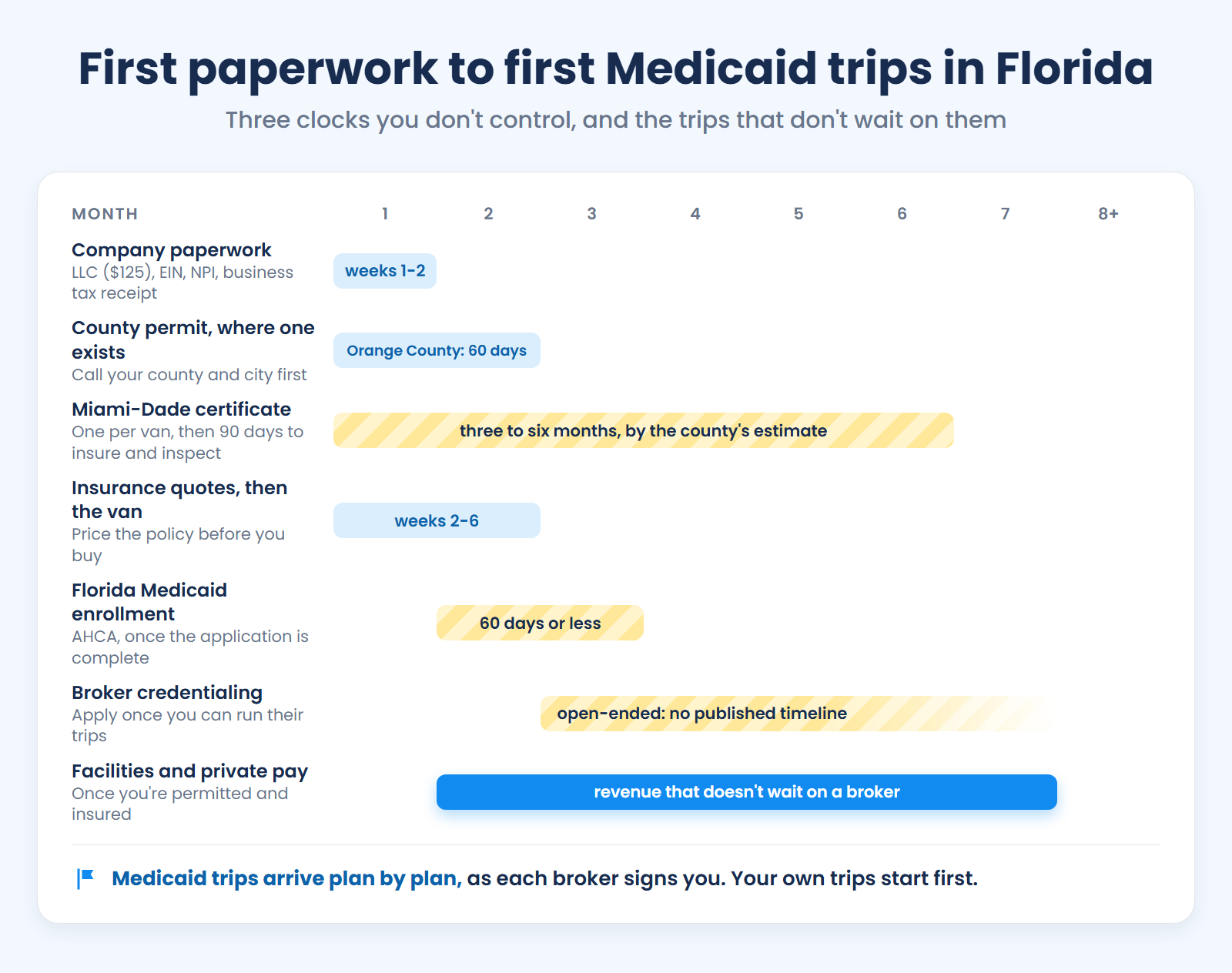
Budget per the cost breakdown above, which already carries six months of fixed bills, because break-even comes months after launch. Your own trips start first. Before you send your first broker application, name the facility and the family who’d pay you next month if every broker said no.
Florida NEMT FAQ
Does Florida require a NEMT license?
No. Florida has no state NEMT license. The state’s ambulance law licenses only advanced and basic life support services, and Florida issues no state permit for vehicles for hire; counties and cities license them [46][47]. On the statute’s plain words, the state treats a van that carries riders for pay as a “nonpublic sector bus,” with federal safety rules and an insurance floor [44][45]. Your real requirements are Florida Medicaid enrollment if you want Medicaid work, broker credentialing, and your county’s rules, from no permit in Jacksonville to a certificate for each van in Miami-Dade [61][7].
Which NEMT brokers handle Florida Medicaid rides?
Nobody holds Florida statewide: each Medicaid health plan hires its own broker. Alivi runs Sunshine Health, and Modivcare runs Humana, Aetna and Community Care Plan [6]. MTM Health runs UnitedHealthcare, Molina’s Medicaid plan and the CMS Plan by Molina [6][5], and Ride2MD runs Simply Healthcare, including Clear Health Alliance, and Florida Community Care [6]. Riders outside a plan go through AHCA’s brokers, Modivcare in Regions A, G, H and I and MTM Health in Regions B through F [23]. Check your county’s plans before you build on any of these.
Is Modivcare still Sunshine Health’s broker?
No. Alivi has arranged Sunshine Health’s Medicaid rides since January 1, 2025, replacing Modivcare, across all five of Sunshine’s Medicaid products [1][30]. Modivcare still holds Humana, Aetna Better Health and Community Care Plan, plus AHCA’s fee-for-service lane in four regions [31][23]. Some guides still put Sunshine under Modivcare.
Can a Florida NEMT company bill Medicaid without a broker?
In practice, no, not for van work. Florida’s transportation fee schedule, dated January 1, 2026, prices only ambulance codes: non-emergency BLS at $137.96 and ALS at $192.73, with no wheelchair, stretcher, ambulatory or ground mileage rate [38]. Van trips pay at rates negotiated with the broker that assigns them [39]. You still need a Florida Medicaid provider ID, usually through limited enrollment, because plans must check that their providers are enrolled [12].
How much money do you need to start a NEMT company in Florida?
About $22,500 to $50,000 for one used wheelchair van, counting six months of fixed bills, before any county permit. The middle case, a $33,000 van bought with 20 percent down, comes to about $27,300. Insurance at about $1 million of liability runs about $17,400 a year in our national model, with about $4,350 due at signing. County permits cost nothing where none is required, as in Jacksonville, and about $1,100 in Miami-Dade and about $1,300 in Broward for one van [61][51][7][52]. There’s no state NEMT license fee, because no state NEMT license exists [46].
How long before a new Florida NEMT company runs its first Medicaid trip?
Months, not weeks. The paperwork takes a few weeks, AHCA says enrollment processing is “60 days or less” from a complete application [16], and a Miami-Dade certificate takes three to six months by the county’s estimate [8]. MTM, Modivcare and Alivi publish no timeline, and MTM and Modivcare say they add companies where they need vans [17][18][65]. Facility and private-pay trips can start once you’re permitted and insured.
Do NEMT drivers need a CDL in Florida?
No CDL, not for a typical wheelchair van. A commercial license starts at 26,001 pounds, or a vehicle designed for more than 15 people including the driver, and an ordinary Class E license covers anything below that [64]. Florida issues no chauffeur license. Plan instead for the broker’s driver file and the county driver registrations in Miami-Dade, Broward and Hillsborough [18][51][52][54].
Are stretcher van trips allowed in Florida?
Yes, for riders who don’t need and aren’t likely to need medical attention during the ride [46]. Florida Medicaid lists wheelchair and stretcher vans as their own provider category [39]. The line is what your crew does: checking vital signs or adjusting a rider’s oxygen is basic life support that needs an EMS license [71]. Miami-Dade, Broward, Pinellas and Orange County license stretcher work, so call your county first [7][52][57][59].
Is the Florida NEMT market worth entering in 2026?
The demand is there. Florida has more people 65 and older than any state but California [26], a Medicaid caseload of 3,947,852 in the fiscal year that ended in June 2026 [20] and 533 dialysis facilities [24]. Few companies hold a Florida Medicaid provider ID, about 295 active van provider IDs in August 2026 against nearly 3,000 Florida NPIs with the NEMT code [29], but the big metros’ private-pay and facility lanes are crowded. Two big plans changed brokers since January 2025, so enter with trip sources you control [1][4].
Key official sources
[1] Sunshine Health, Alivi transportation FAQ (read October 19, 2026): Alivi has arranged Sunshine Health’s Medicaid rides since January 1, 2025, replacing Modivcare. https://www.sunshinehealth.com/members/medicaid/benefits-services/transportation-services/alivi-faq.html
[2] AHCA, Florida Medicaid monthly enrollment report for September 30, 2026 (read October 19, 2026): members by plan, product and region, and fee-for-service enrollment. https://ahca.myflorida.com/file/medicaid/ENR_202609.xls
[3] Modivcare restructuring press releases filed with the SEC as Form 8-K exhibits (read October 19, 2026): the August 20, 2025 Chapter 11 filing, and the December 29, 2025 emergence “as a privately-owned company” with more than 85 percent of its debt eliminated and services uninterrupted. https://www.sec.gov/Archives/edgar/data/1220754/000143774925027478/ex_855729.htm and https://www.sec.gov/Archives/edgar/data/1220754/000143774925038831/ex_902789.htm
[4] UnitedHealthcare Community Plan, 2026 Care Provider Manual, Florida Statewide Medicaid Managed Care (version PMI 09302026; read October 19, 2026): non-emergency transportation through MTM, effective March 1, 2026. https://www.uhcprovider.com/content/dam/provider/docs/public/admin-guides/comm-plan/FL-Care-Provider-Manual-Statewide-Medicaid-Managed-Care.pdf
[5] Molina Healthcare of Florida, Children’s Medical Services (CMS) Plan member and provider pages, transition FAQs and provider orientation (read October 19, 2026): the plan went live with Molina on October 1, 2026; rides through MTM Health; Sunshine contracts don’t transfer. https://www.molinahealthcare.com/medicaid/fl/cms/benefits-services and https://www.molinahealthcare.com/providers/fl/cms
[6] Agency for Health Care Administration (AHCA), Administrative Subcontractors and Affiliates Report, Cumulative Q3 2026 (read October 19, 2026): each Statewide Medicaid Managed Care plan’s transportation subcontractor. https://ahca.myflorida.com/file/medicaid/Administrative_Subcontractors_and_Affiliates_Report_Cumulative_Q3_2026.pdf
[7] Miami-Dade County Code, Chapter 4, Article III (nonemergency medical transportation), codified through Ord. 26-59, and the county’s Non-Emergency Certificate application (read October 19, 2026): one certificate per vehicle, the Director’s decision, inspections by model year, the 15-model-year limit, $100,000/$300,000/$50,000 insurance, the $25 background check. https://library.municode.com/fl/miami_-_dade_county/codes/code_of_ordinances?nodeId=PTIIICOOR_CH4AMMETRVE and https://www.miamidade.gov/resources/licenses/documents/non-emergency-certificate.pdf
[8] Miami-Dade County, Non-Emergency Transportation Certificate license page (read October 19, 2026): scope, the county’s description of a committee hearing and a commission vote, and “three to six months from the time of application.” https://www.miamidade.gov/global/license.page?Mduid_license=lic1500577699583202
[9] s. 409.966(2), Florida Statutes (2026): the nine Statewide Medicaid Managed Care regions, A through I, defined county by county (read October 19, 2026). https://www.flsenate.gov/Laws/Statutes/2026/409.966
[10] Florida Division of Corporations (Sunbiz), LLC fees and annual report deadlines (read October 19, 2026). https://dos.fl.gov/sunbiz/forms/fees/llc-fees/ and https://dos.fl.gov/sunbiz/manage-business/efile/annual-report/
[11] Google, Maps User Generated Content Policy Help, “Prohibited & restricted content” (read October 14, 2026): incentives for reviews and conflicts of interest. https://support.google.com/contributionpolicy/answer/7400114
[12] AHCA, Statewide Medicaid Managed Care model contract, Attachment II Core Contract Provisions and Exhibit II-A (Managed Medical Assistance), update July 1, 2026 (read October 19, 2026): network agreements while enrollment is pending (up to 60 days), transportation provider standards (lift-equipped vehicles meeting ADA regulations, two-way communications, working air conditioning and heat, annual vehicle safety inspections, driver background checks, liability insurance), advance notice and riders’ dependent children. https://ahca.myflorida.com/file/medicaid/Health_Attachment%20II%20-Core%20Contract%20Provisions_July%202026.pdf and https://ahca.myflorida.com/file/medicaid/Health_Exhibit%20II-A_Managed%20Medical%20Assistance%20%28MMA%29%20Program_July%202026.pdf
[13] ss. 409.907, 435.03 and 435.04, Florida Statutes (2026): Level 2 screening for providers and principals, the Level 1 carve-out for nonemergency transportation drivers, the surety bond, the enrollment effective date, and what each screening level contains (read October 19, 2026). https://www.flsenate.gov/Laws/Statutes/2026/409.907, http://www.leg.state.fl.us/statutes/index.cfm?App_mode=Display_Statute&URL=0400-0499/0435/Sections/0435.03.html and https://www.flsenate.gov/Laws/Statutes/2026/435.04
[14] Florida Medicaid Web Portal, provider enrollment page (read October 19, 2026): the online Enrollment Wizard and the nine-digit provider number issued on approval. https://portal.flmmis.com/FLPublic/Provider_ProviderServices/Provider_Enrollment/tabId/42/Default.aspx
[15] Florida Medicaid Provider Enrollment Policy (February 2026), incorporated by Rule 59G-1.060, F.A.C., effective April 8, 2026 (read October 19, 2026): full and limited enrollment, transportation provider type 41, the limited screening risk category and site visits, the transportation document list (local license, surety bond, $100,000/$200,000 liability proof), the 21-day deficiency rule and no application fee for transportation providers; plus Sunshine Health’s August 31, 2024 notice to providers on AHCA enrollment, with its claim denial codes. https://www.flrules.org/gateway/readRefFile.asp?refId=19181&filename=Florida%20Medicaid%20Provider%20Enrollment%20Policy%20February%202026.pdf and https://www.sunshinehealth.com/newsroom/mma-enrollment-guide.html
[16] AHCA, provider enrollment readiness page (read October 19, 2026): “Processing is 60 days or less from the date your complete application is received.” https://ahca.myflorida.com/provider/readiness.html
[17] MTM Health, provider onboarding pages (read October 19, 2026): the six-step process and need-gated network language. https://www.mtm-inc.net/driverswanted/ and https://www.mtm-inc.net/service-providers/
[18] Modivcare, transportation provider page (read October 19, 2026): driver credentials, vehicle standards, insurance coverage types with limits that “vary by state,” and the map of priority areas. https://www.modivcare.com/transportation-providers-contact-us/
[19] CMS, data.medicaid.gov, State Medicaid and CHIP Applications, Eligibility Determinations, and Enrollment Data (dataset 6165f45b-ca93-5bb5-9d06-db29c692a360), June 2026 preliminary counts, the newest month posted (read October 15, 2026; no newer month on October 19, 2026): Florida fourth in total Medicaid and CHIP enrollment, behind California, New York and Texas. https://data.medicaid.gov/dataset/6165f45b-ca93-5bb5-9d06-db29c692a360
[20] Florida Legislature, Office of Economic and Demographic Research, Social Services Estimating Conference on Medicaid (July 2026; read October 19, 2026): caseload, managed care share and expenditure forecast. https://edr.state.fl.us/content/conferences/medicaid/execsummary.pdf and https://edr.state.fl.us/content/conferences/medicaid/managedcarefeeforservice.pdf
[21] AHCA, Statewide Medicaid Managed Care 3.0 overview presentation (January 24, 2025; read October 19, 2026): the February 1, 2025 go-live, contracts through 2030, and the nine new regions with the old numbered regions they replace. https://faba.memberclicks.net/assets/PublicPolicy/AHCA/Statewide%20Medicaid%20Managed%20Care-Behavior%20Analysis%20Presentation-1-24-2025.pdf
[22] s. 409.973(1)(cc), Florida Statutes (2026): “Transportation to access covered services” among the benefits every managed medical assistance plan must cover (read October 19, 2026). https://www.flsenate.gov/Laws/Statutes/2026/409.973
[23] AHCA, 1915(b) Non-Emergency Medical Transportation waiver renewal, July 1, 2025 to June 30, 2027, and the waiver page’s broker contacts (read October 19, 2026): Modivcare for Regions A, G, H and I, MTM Health for Regions B through F, for members not required to enroll in a plan. https://ahca.myflorida.com/file/medicaid/NEMT%20Renewal%202025-2027.pdf and https://ahca.myflorida.com/medicaid/medicaid-policy-quality-and-operations/medicaid-policy-and-quality/medicaid-policy/federal-authorities/federal-waivers/fl-1915-b-managed-care-waiver.html
[24] CMS Provider Data Catalog, Dialysis Facilities dataset (data updated June 2026; Florida counts by county read October 19, 2026). https://data.cms.gov/provider-data/dataset/23ew-n7w9
[25] Commission for the Transportation Disadvantaged, 2025 Annual Operating Report, FY 2024-25 (read September 25, 2026): each county’s community transportation coordinator, coordinator types, each county’s rural or urban operating environment, and trips by provider. https://fdotwww.blob.core.windows.net/sitefinity/docs/default-source/ctd/archive/studiesreports/2025-aor-report---fy-2024-2025-%28final%29---website.pdf?sfvrsn=a9ec0a0e_1
[26] U.S. Census Bureau, American Community Survey 2024 1-year estimates, table B01001 (sex by age), all states, via Census Reporter (read October 19, 2026): residents 65 and older by state. https://api.censusreporter.org/1.0/data/download/latest?table_ids=B01001&geo_ids=040|01000US&format=csv
[27] BEBR and EDR, Florida Estimates of Population 2025, Table 14: shares 65 and older by county, 2023 age estimates (read October 19, 2026). https://edr.state.fl.us/content/population-demographics/data/Estimates2025.pdf
[28] Stanley K. Smith and Mark House, “Temporary Migration: A Case Study of Florida,” Population Research and Policy Review (2007), from BEBR’s 2000-2003 monthly household surveys (read October 19, 2026): temporary residents by month, age and reason. https://www.bebr.ufl.edu/sites/default/files/PRPR%202007%20%28Temp%20Migr%29.pdf
[29] Florida Medicaid Provider Master List (FLMMIS portal download, August 26, 2026): about 295 active provider IDs with the NEMT van taxonomy; CMS NPPES NPI Registry API (August 26, 2026): 2,975 Florida NPIs with taxonomy 343900000X; and the NPPES full data file for July 12, 2026 (counted October 19, 2026): 2,869 Florida practice-location NPIs with the code, 1,392 of them first issued in 2023 or later. https://portal.flmmis.com/FLPublic/Provider_ProviderServices/Provider_ManagedCare/tabId/61/Default.aspx and https://npiregistry.cms.hhs.gov/api/
[30] Sunshine Health, provider transportation quick reference (read October 19, 2026): Alivi for all five Sunshine Medicaid products. https://www.sunshinehealth.com/providers/Billing-manual/transportation.html
[31] Modivcare, Florida member page (read October 19, 2026): the Florida plans it serves (Humana MMA and LTC, Aetna Better Health, Community Care Plan) and AHCA fee-for-service. https://www.mymodivcare.com/members/fl/
[32] Community Care Plan, Medicaid member handbook (dated July 1, 2026; read October 19, 2026): Modivcare as the transportation vendor. https://www.ccpcares.org/wp-content/uploads/Medicaid-Member-Handbook.pdf
[33] Simply Healthcare Plans, SMMC provider resource guide (September 2026; read October 19, 2026): Ride2MD for nonemergency transportation statewide. https://provider.simplyhealthcareplans.com/docs/gpp/FLFL_SMH_SimplyResourceGuide.pdf?v=202503032005
[34] Florida Community Care, care resources page (read October 19, 2026): “Florida Community Care has contracted with Ride2MD for transportation services.” https://fcchealthplan.com/find-the-care-you-need/
[35] Molina Healthcare of Florida, Medicaid plan page (read October 19, 2026): rides through MTM Health; Statewide Medicaid Managed Care service area Region I (Miami-Dade and Monroe). https://www.molinahealthcare.com/medicaid/fl
[36] Sunshine Health newsroom, CMS Health Plan transition notice (April 30, 2026; read October 19, 2026): the Children’s Medical Services plan moved to Molina Healthcare on October 1, 2026, and provider contracts with Sunshine don’t transfer. https://www.sunshinehealth.com/newsroom/cms.html
[37] MTM Health, Florida fee-for-service page (read October 19, 2026): regions 3 through 8, riders not enrolled in managed care, the $1 copayment each way. https://www.mtm-inc.net/floridaffs/
[38] Florida Medicaid Transportation Services Fee Schedule, January 1, 2026, incorporated by Rule 59G-4.002, F.A.C. (rule amendment effective October 26, 2026; read October 19, 2026): ambulance codes only, ground and air, plus an “as negotiated” line, with no wheelchair, stretcher, ambulatory or ground mileage code. https://www.flrules.org/gateway/readRefFile.asp?refId=19430&filename=Transportation%20Services%20Fee%20Schedule.pdf and https://www.flrules.org/gateway/ruleno.asp?id=59G-4.002
[39] Florida Medicaid Non-Emergency Transportation Services Coverage Policy (November 2019), incorporated by Rule 59G-4.330, F.A.C., still the current version (read October 19, 2026): plans follow it unless their contract says otherwise; eligible provider types, including wheelchair and stretcher vans; the escort rule; the $1 copayment; time spent waiting listed as not covered; non-ambulance services paid at a negotiated rate. https://www.flrules.org/gateway/readRefFile.asp?refId=11228&filename=59G-4.330%20NET%20Coverage%20Policy_2019_FINAL.docx and https://www.flrules.org/gateway/ruleno.asp?id=59G-4.330
[40] ch. 427, Florida Statutes (2026), ss. 427.011, 427.015, 427.0155 and 427.016: the Transportation Disadvantaged coordinated system, coordinator and operator definitions, the coordinator’s duty to subcontract where it’s more cost-effective, and the funds mandate (read October 19, 2026). http://www.leg.state.fl.us/statutes/index.cfm?App_mode=Display_Statute&URL=0400-0499/0427/Sections/0427.011.html, http://www.leg.state.fl.us/statutes/index.cfm?App_mode=Display_Statute&URL=0400-0499/0427/Sections/0427.015.html, http://www.leg.state.fl.us/statutes/index.cfm?App_mode=Display_Statute&URL=0400-0499/0427/Sections/0427.0155.html and http://www.leg.state.fl.us/statutes/index.cfm?App_mode=Display_Statute&URL=0400-0499/0427/Sections/0427.016.html
[41] Commission for the Transportation Disadvantaged, Annual Performance Report FY 2024-25 (the latest posted; read October 19, 2026): system trips and revenues, the Trip and Equipment Grant, purchasing-agency programs outside the Commission’s authority. https://fdotwww.blob.core.windows.net/sitefinity/docs/default-source/ctd/archive/studiesreports/2024-2025-ctd-annual-report.pdf?sfvrsn=f2f0e6be_1
[42] Rule 41-2.006, F.A.C.: the coordinated system’s $200,000/$300,000 minimum liability insurance and the 7-working-day subcontractor payment rule tied to s. 287.0585, Fla. Stat. (effective September 3, 2018; read October 19, 2026). https://flrules.org/gateway/ruleno.asp?id=41-2.006
[43] City of Orlando: the Police Department’s Start a Transportation Company page and vehicle-for-hire permit application ($250 application, $200 a vehicle permit; the unit at 407-246-2855), and City Code Chapter 55, vehicles for hire (insurance at the s. 324.031 amounts with the city as additional insured; the exemption for transportation-disadvantaged trips under a coordinator’s contract, in marked vehicles) (read October 19, 2026). https://www.orlando.gov/Public-Safety/OPD/Start-a-Transportation-Company and https://library.municode.com/fl/orlando/codes/code_of_ordinances?nodeId=TITIICICO_CH55RETALILUPAVESHOTVERE
[44] ss. 316.003(8) and (49), 316.302(10) and 316.70, Florida Statutes (2026): the “bus” and “nonpublic sector bus” definitions, and the federal safety rules (49 C.F.R. parts 382, 385 and 390-397) that apply to nonpublic sector buses (read October 19, 2026). https://www.flsenate.gov/Laws/Statutes/2026/316.70 and http://www.leg.state.fl.us/statutes/index.cfm?App_mode=Display_Statute&URL=0300-0399/0316/Sections/0316.003.html
[45] ss. 627.742 and 627.733(1), Florida Statutes (2026): the insurance every nonpublic sector bus must carry, $100,000/$300,000/$50,000 or a $300,000 combined policy, “in addition to any other insurance requirements”; and the personal injury protection security required of every registered vehicle except school buses and limousines (read October 19, 2026). https://www.flsenate.gov/Laws/Statutes/2026/627.742 and http://www.leg.state.fl.us/statutes/index.cfm?App_mode=Display_Statute&URL=0600-0699/0627/Sections/0627.733.html
[46] ss. 401.23 and 401.25, Florida Statutes (2026): the ambulance definition (“requiring or likely to require medical attention during transport”) and the license for anyone who operates or advertises advanced or basic life support transportation, with the county certificate of public convenience and necessity (read October 19, 2026). https://www.flsenate.gov/Laws/Statutes/2026/401.23 and https://www.flsenate.gov/Laws/Statutes/2026/401.25
[47] Florida House of Representatives, staff analysis of CS/HB 377 (2024) (read October 19, 2026): no state permit for vehicles for hire, the counties’ s. 125.01(1)(n) authority to license them in unincorporated areas, and local examples. https://www.flsenate.gov/Session/Bill/2024/377/Analyses/h0377e.COM.PDF
[48] 49 C.F.R. 390.5T, the federal definition of a commercial motor vehicle, Legal Information Institute copy (read October 19, 2026): a vehicle designed or used to carry more than 8 passengers, including the driver, for compensation, or one rated at 10,001 pounds or more. https://www.law.cornell.edu/cfr/text/49/390.5T
[49] Florida Highway Patrol, Office of Commercial Vehicle Enforcement: Safety Enforcement and Florida USDOT Numbers pages (read October 19, 2026). https://www.flhsmv.gov/florida-highway-patrol/commercial-vehicle-enforcement/safety-enforcement/ and https://www.flhsmv.gov/florida-highway-patrol/commercial-vehicle-enforcement/safety-enforcement/florida-usdot-numbers/
[50] s. 320.0603, Florida Statutes (2026), created by ch. 2024-28: vehicle-for-hire license reciprocity, with subsection (4) excluding stretcher and wheelchair transportation and riders whose condition makes a regular common carrier impractical (read October 19, 2026). http://www.leg.state.fl.us/statutes/index.cfm?App_mode=Display_Statute&URL=0300-0399/0320/Sections/0320.0603.html
[51] Miami-Dade County Implementing Order 4-136, for-hire transportation fee schedule (ordered September 28, 2017; the schedule the county’s license page links; read September 25, 2026): certificate, chauffeur registration and inspection fees. https://documents.miamidade.gov/ao-io/IO/IO-04-136.pdf
[52] Broward County Consumer Protection Division, forms: the Non-Emergency Medical Transportation Service license and vehicle permit application (revised July 28, 2026) and the chauffeur registration application (revised October 8, 2026) (read October 19, 2026): fees as of October 1, 2025, insurance, driver training. https://www.broward.org/consumer/Forms
[53] Hillsborough County Tax Collector, vehicle-for-hire business information and payments and fees pages (fees read October 19, 2026): certificate, vehicle permit and driver badge fees, insurance. https://www.hillstaxfl.gov/other-services/vehicle-for-hire/business-information/ and https://www.hillstaxfl.gov/other-services/vehicle-for-hire/payments-fees/
[54] Hillsborough County Code, Chapter 10, Article XVI, vehicles for hire (Ord. 17-22) (read October 19, 2026): handicab rules, driver licenses with fingerprint screening, inspections. https://library.municode.com/fl/hillsborough_county/codes/code_of_ordinances%2C_part_a?nodeId=HICOCOORLA_CH10BU_ARTXVIVEHI
[55] Palm Beach County Consumer Affairs, vehicle-for-hire business permit application (form REV. 01-2020; read September 25, 2026): fees, insurance and the non-medical wheelchair and stretcher category. https://discover.pbcgov.org/publicsafety/consumeraffairs/CA_PDFs/VFHBusinessApp.pdf
[56] Palm Beach County Code, Chapter 19, Article IX, vehicles for hire (read October 19, 2026): the two-vehicle minimum, inspections and insurance. https://library.municode.com/fl/palm_beach_county/codes/code_of_ordinances?nodeId=PABECOCO_CH19MOVETR_ARTIXVEHI
[57] Pinellas County Code, Chapter 54, emergency medical services (read October 19, 2026): certificates for wheelchair and stretcher transport, and the bar on using an uncertificated service. https://library.municode.com/fl/pinellas_county/codes/code_of_ordinances?nodeId=PTIIPICOCO_CH54EMSE
[58] Pinellas County, ambulance and transport services page (read October 19, 2026): county-certificated wheelchair and stretcher transport providers, with certificates approved by the Board of County Commissioners on July 22, 2025. https://pinellas.gov/safety-emergency-services-transports/
[59] Orange County Code, Chapter 20, Article III, Division 3, alternative transportation services (read October 19, 2026): county licenses and per-vehicle permits for wheelchair and stretcher services, and a decision within 60 days. https://library.municode.com/fl/orange_county/codes/code_of_ordinances?nodeId=PTIIORCOCO_CH20HEHUSE_ARTIIIEMNOMECATR
[60] County codes read on Municode on October 19, 2026: Osceola County Code ch. 12, art. II (a permit for each nonemergency vehicle after a public hearing, a $100 application, a $10 chauffeur registration, $100,000/$300,000/$50,000 insurance, annual inspection); Sarasota County Code ch. 62, art. VIII (service and vehicle permits from the Florida Department of Health in Sarasota County within 30 days, $100,000/$300,000/$50,000 or $300,000 insurance, and the oxygen rule for riders who self-administer, 500 liters at most on board); Alachua County Code ch. 52, art. II (certificates for nonemergency transport providers, a 30-day protest window, a decision within 90 days, and an ambulance definition that includes riders who must be transported on a stretcher); Lee County Code sec. 10-159(b)(5) and Polk County Code sec. 11.8-17(b)(3) (non-emergency stretcher vans, and in Lee wheelchair vans, exempt from their ambulance certificates).
[61] City of Jacksonville Ordinance Code, Chapter 220, vehicles for hire (read October 19, 2026). https://library.municode.com/fl/jacksonville/codes/code_of_ordinances?nodeId=TITVIBUTROC_CH220VEHI
[62] Florida Department of Health, EMS service provider licensing page and licensed-provider roster (roster processed October 6, 2026; read October 19, 2026): 346 licensed providers, of which 304 advanced life support, 34 air ambulance and 8 basic life support. https://www.floridahealth.gov/licensing-regulations/emergency-medical-services-system/ems-service-provider/
[63] MTM Health, release on finalizing its acquisition of Access2Care (undated page; read October 19, 2026). https://www.mtm-inc.net/mtm-finalizes-acquisition-of-access2care-expanding-market-leadership-in-nemt-sector/
[64] ss. 322.01 and 322.54, Florida Statutes (2026): the commercial motor vehicle definition (26,001 pounds, or more than 15 persons including the driver) and the license classes (A, B, C and E) (read October 19, 2026). https://www.flsenate.gov/Laws/Statutes/2026/322.01 and https://www.flsenate.gov/Laws/Statutes/2026/322.54
[65] Alivi, transportation provider page (read October 19, 2026): the web interest form for providers (state and counties of service, NPI number, numbers of drivers and vehicles, levels of service, dispatch platform), with no published insurance limits, vehicle or driver requirements, or timeline. https://alivi.com/become-a-transportation-provider/
[66] ch. 324, Florida Statutes (2026), ss. 324.021, 324.031 and 324.032: financial responsibility amounts, the $125,000/$250,000/$50,000 taxicab tier, the for-hire options, and s. 324.021(7)(d), which points nonpublic sector buses to s. 627.742 (read October 19, 2026). https://www.leg.state.fl.us/statutes/index.cfm?App_mode=Display_Statute&URL=0300-0399%2F0324%2F0324.html
[67] The Florida Bar, consumer pamphlet on automobile insurance (updated May 2025; read October 19, 2026): personal injury protection and property damage requirements for private cars; bodily injury liability “generally not required.” https://www.floridabar.org/public/consumer/tip002/
[68] Florida Department of Financial Services, workers’ compensation coverage requirements and non-construction exemptions (read October 19, 2026). https://myfloridacfo.com/division/wc/employee/employer-coverage-requirements and https://www.myfloridacfo.com/division/wc/employer/exemptions/non-construction
[69] s. 316.87, Fla. Stat.: nonemergency medical transportation by transportation network companies, driver screening equivalence, and preservation of ch. 401 licensure (read October 19, 2026). http://www.leg.state.fl.us/statutes/index.cfm?App_mode=Display_Statute&URL=0300-0399/0316/Sections/0316.87.html
[70] Florida Care Provider Background Screening Clearinghouse, screening information (read October 19, 2026): $60 plus the Livescan provider’s fee, five years of fingerprint retention, and “The full process typically takes 5 to 7 business days.” https://info.flclearinghouse.com/screening-information.html
[71] Florida Department of Health, EMS service provider frequently asked questions (read October 19, 2026): checking vital signs or altering a rider’s oxygen is basic life support that needs an EMS license; rider-operated prescription oxygen. https://www.floridahealth.gov/licensing-regulations/emergency-medical-services-system/ems-service-provider/frequently-asked-questions/
[72] Community Care Plan, Request for Proposal for Non-Emergency Transportation Services (March 25, 2026; read September 28, 2026): the plan’s 2026 bid for its ride vendor. https://ccpcares.org/wp-content/uploads/2026-Transportation-RFP-03.25.2026vF.pdf
[73] Florida Department of Revenue, Sales and Use Tax on Motor Vehicles, brochure GT-800030 (R. 08/22; read September 25, 2026), and Form DR-15DSS, discretionary sales surtax rates for calendar year 2025 (read October 19, 2026): 6% state sales tax on a vehicle, with the county surtax applying to the first $5,000 of the price. https://floridarevenue.com/Forms_library/current/brochure/gt800030.pdf and https://floridarevenue.com/Forms_library/current/dr15dss.pdf
[74] FLHSMV, Schedule of Motor Vehicle Title and Lien Fees (Rev. 04/26) and License Plate Rate Chart, HSMV 83140 (Rev. 08/26) (read September 25, 2026): the for-hire title fee and the for-hire registration rate per hundred pounds plus the metal plate. https://www.flhsmv.gov/pdf/proc/fees/fees-01.pdf and https://www.flhsmv.gov/pdf/forms/83140.pdf
[75] U.S. Small Business Administration: microloans and 7(a) loans (read October 19, 2026). https://www.sba.gov/funding-programs/loans/microloans and https://www.sba.gov/funding-programs/loans/7a-loans
[76] Florida SBDC Network, no-cost small business consulting from more than 40 offices (read October 19, 2026). https://floridasbdc.org/
[77] ch. 2023-173, Laws of Florida (CS/CS/HB 5): the repeal of the Microfinance Loan Program (s. 288.9934) and the transfer of Enterprise Florida’s duties to the Department of Commerce (read October 19, 2026). http://laws.flrules.org/2023/173
[78] s. 288.9935, Florida Statutes (2026), the Microfinance Guarantee Program: guarantees on loans of $50,000 to $250,000 for small businesses (read October 19, 2026). http://www.leg.state.fl.us/statutes/index.cfm?App_mode=Display_Statute&URL=0200-0299/0288/Sections/0288.9935.html
Last verified against the sources above in October 2026. Florida requirements, plan contracts and broker assignments change; check the primary sources before acting, and treat this guide as education, not legal advice.
About the author
James O'Donnell cofounded Duet and leads its sales, partnerships, and growth services. He talks with NEMT operators every week, hosts the NEMT Growth podcast, and answers Duet's sales line himself. More about Duet's founders →
Starting in a nearby state?
Want more trips and less busywork?
See how Duet runs and grows NEMT businesses in a 30-minute demo.