
Article
How to Start a Medical Transportation Business (NEMT)
Costs, licensing, insurance, broker enrollment, and the order that wastes the least money.
By James O'Donnell, Cofounder and COO, Duet · · Updated
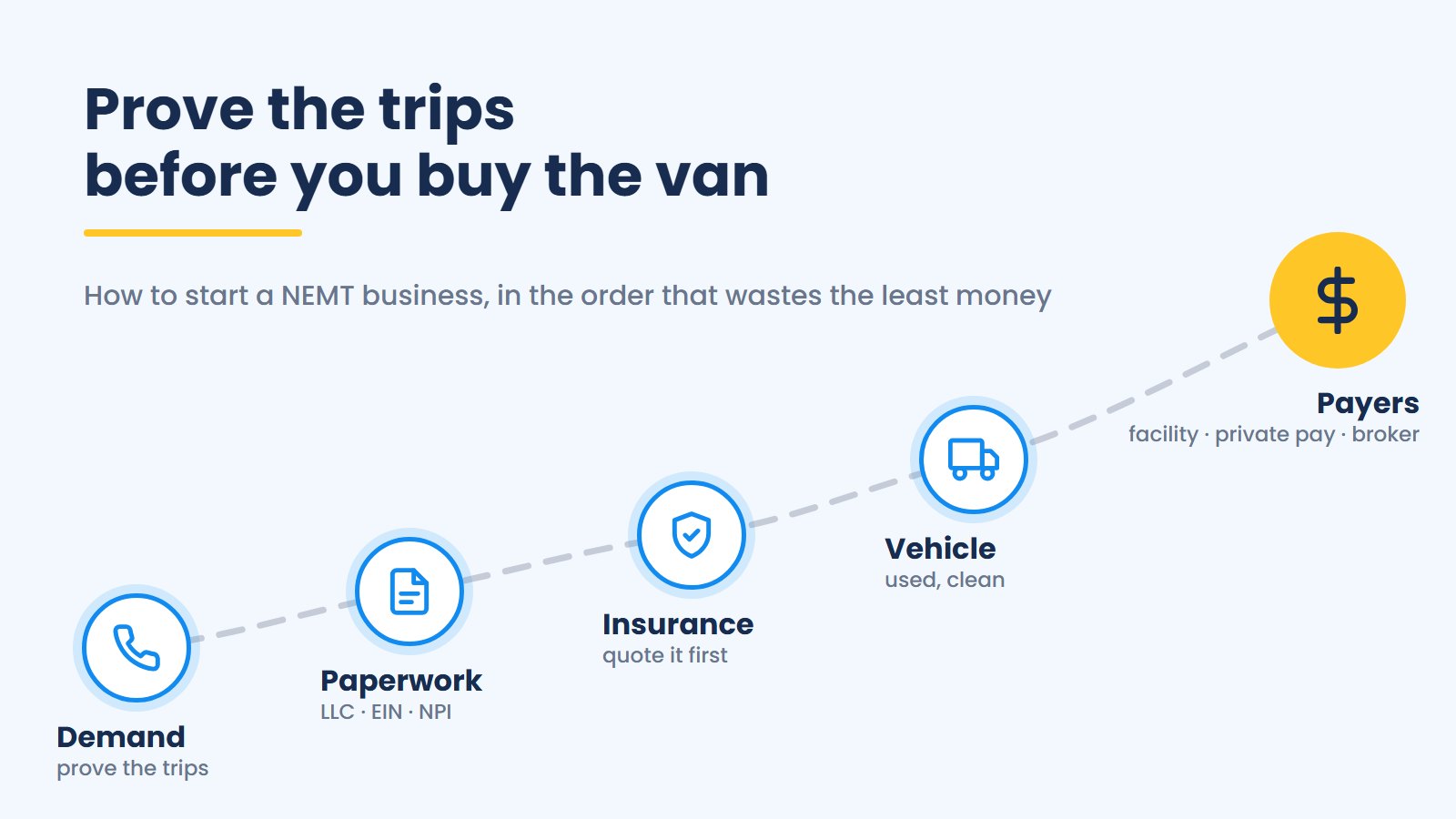
The new NEMT owners I meet that go on to make it are the ones that obsess about trips. Not vans. They’re asking who in their town needs rides, who pays for them, and how do they become the company that gets called. This guide will walk you through the exact steps to line up trips, file paperwork, make the right purchases, and get started.
The short version:
- Cost: about $23,000 to $51,000 in cash for one used wheelchair van, counting six months of fixed bills.
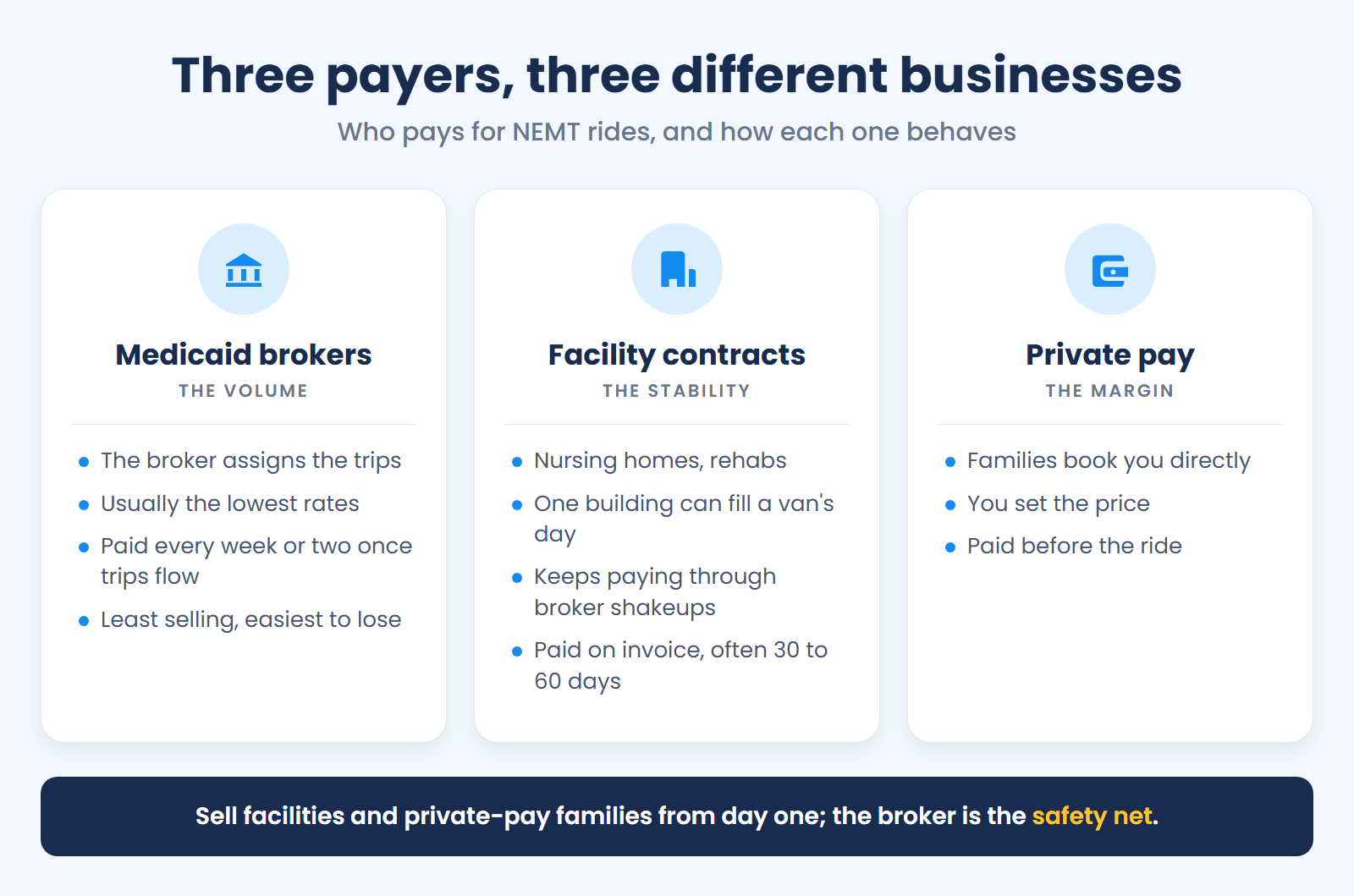
- Who pays: Medicaid rides through a broker (the volume), facility contracts (the stability), and private-pay families (the margin).
- First Medicaid or broker revenue: months, not weeks, and more than a year for some owners, because licensing, insurance, and broker approval all have queues you don’t control.
- Drivers: most states don’t require a CDL (commercial driver’s license) for a van designed for fewer than 16 people, counting the driver. California’s line is lower, and New York ambulette drivers always need one. Background checks are standard, and most brokers add drug testing; some add certifications like CPR.
- The order: prove the trips before you buy the van. Sell facilities and private-pay families from day one; the broker is the safety net.
What does a NEMT business do, and who pays for the rides?
A NEMT (non-emergency medical transportation) company takes riders to medical appointments they’d otherwise miss, and three main kinds of payers cover those rides: Medicaid, facilities and private-pay families. It runs wheelchair vans, ambulatory vehicles (regular cars and minivans for riders who can walk), and sometimes stretcher vans.
Each one pays on its own clock:
- Medicaid trips, assigned through a broker, a company hired to hand out Medicaid rides. Once trips flow, brokers pay every week or two: MTM’s 2018 Mississippi handbook paid weekly for trips submitted 9 to 15 days earlier, and MediDrive pays every two weeks in Colorado.
- Direct contracts with facilities like nursing homes. They pay on invoice terms, often 30 to 60 days after the trip.
- Private-pay riders and families who book directly. They pay before the ride: most providers take a card at booking and charge it at least 24 hours before pickup, or send a payment link due by then.
Medicaid is the volume. Federal Medicaid rules make every state’s Medicaid agency get members the rides they need to and from care [1], but in most states you can’t bill Medicaid directly for most van trips. The state, or each Medicaid health plan (a private plan the state pays to cover Medicaid members), hires a broker instead: companies like Modivcare, MTM Health, Verida, WellTrans, or Tennessee Carriers, one of Tennessee’s two Medicaid ride vendors. Pennsylvania is one exception: outside Philadelphia, it runs its Medicaid rides county by county. You sign up as one of the broker’s approved transportation companies. They call that enrolling in the network. The broker assigns trips and, in most states, pays you, usually at the lowest rates you’ll see.
Some states also let you bill Medicaid directly for members who aren’t in a health plan. That’s the fee-for-service lane, and your state guide says whether yours is open: Illinois lets those riders pick an enrolled company, while Colorado’s lane is closed to new companies and ends for everyone on January 1, 2027.
Facilities are the stability. One rehab hospital that trusts you can fill a van’s whole day, and it keeps paying straight through a broker shakeup. Dialysis is the exception. The rides are great, but in my experience most dialysis riders are on Medicaid, so their trips usually come through the broker, not the clinic.
Private pay is the margin, because you set the price. When Rachel Scholler sold her rural Wisconsin NEMT company, the buyer stopped trying to work with brokers 90 days in. As she said on our podcast, they were “offering 30 to 40% less than what our private rates are” [2]. In Los Angeles the gap can be wider. Medi-Cal, California’s Medicaid program, pays about $35 at its 2026 fee-for-service rate for a 10-mile wheelchair trip, while one Los Angeles-area company publishes $110 to $130 as its typical private-pay price for that trip.
Prospects often ask me on demos whether Duet is a broker. It isn’t. We don’t hold a Medicaid or health plan contract, decide who runs a Medicaid trip, set your rate or take a cut. Whoever pays for a trip pays you directly. NEMT software like Duet runs private-pay, facility-billed and broker trips side by side, and getting approved by each broker stays your job.
How much money do you need to start?
Plan on about $23,000 to $51,000 in cash to start with one used wheelchair van in 2026, counting six months of fixed bills before payments arrive steadily. The low end is an older van, financed. The high end is a 2016-2019 van bought outright, and a 2020-or-newer van bought outright takes about $82,700. The van you pick moves the total by tens of thousands of dollars, and your state moves it by a few thousand. Our line-by-line startup budget prices every item.
If you’re starting a wheelchair transportation business, that’s your number. The cheapest honest start is ambulatory only, in a vehicle you already own, where your state and payers accept ambulatory-only providers. You skip the van and the conversion, but not the commercial insurance, and you give up wheelchair riders.
| Line item | Typical range (2026, one used wheelchair van) |
|---|---|
| Forming the LLC (limited liability company) | $50 to $300 to file (California adds an $800 annual LLC tax for LLCs formed in 2026) |
| EIN (your federal tax ID) and NPI (your healthcare ID number) | Free |
| Medicaid application fee | $0 to $850 by state, including the $750 federal fee in 2026 where your state charges it |
| Permits and owner screening | $0 to $700; a few places charge far more |
| Vehicle | Older, high-mileage wheelchair van $15,000 to $25,000; 2016-2019 about $33,000; 2020 or newer about $62,600; plus about 3% to 10% for tax, title and registration. Financed, 10% to 25% down |
| Commercial auto insurance | $14,400 to $21,600 a year ($1,200 to $1,800 a month) per wheelchair van for a new company in its first year. Down payment a fifth to a quarter of the year’s premium, sometimes all of it |
| Equipment and lettering | $850 to $1,300, more if a used van lacks wheelchair securement |
| Driver screening and training (drug test, background check, CPR, wheelchair securement) | $250 to $1,200 per driver, starting with you |
| Phone and basic marketing | $0 to $700 up front (a Google Business Profile is free), then $10 to $19 a month for a phone line |
| Six months of fixed bills | About $7,900 if you buy a $33,000 van outright, or $11,600 if you finance it: the insurance installments, a phone line, and any van payment |
These are 2026 prices, with the 2016-2019 and 2020-or-newer vans at median dealer asking prices from September 2026. Your own living costs come on top, and so does fuel, which rises with trips.
Insurance: about $1,200 to $1,800 a month in year one
A new company pays about $1,200 to $1,800 a month per wheelchair van in its first year. Few carriers write NEMT, and fewer take a one-van startup. Brokers and facilities commonly ask for a second policy on top of the auto policy: general liability, which covers injuries and damage that don’t involve driving, like a rider who trips on the way into a clinic. SafeRide, a ride vendor for Medicaid health plans in several states, and Arizona’s Medicaid plan contracts worth $50,000 or more both set it at $1 million per occurrence and $2 million a year. Workers’ comp is required by your fourth employee in every state our guides cover except Missouri and Tennessee, where it starts at your fifth, and Texas, where it’s optional for most employers. Get quotes on the van you’ll actually buy before you sign for it.
Cash: the wait before Medicaid pays you
Plan on months before Medicaid pays you anything. State enrollment clocks alone vary widely: 16 to 22 days for a clean application in North Carolina (July to September 2026), up to 180 days for California to decide, and none at all in Missouri, which doesn’t enroll van companies. Then each broker credentials you on its own clock, so ask each one how long its recent approvals have taken.
A one-van owner in the Bay Area told me on a demo this summer that she was 13 months in, still paying insurance, with no Medi-Cal trips yet. Facilities and private-pay families are what carry you through the wait, as long as you hold whatever permit your state requires for those trips. Keep the day job until the trips say otherwise.
What are the steps to start a NEMT business?
Starting a NEMT business takes twelve steps. They’re ordered so you spend the big money (the vehicle, the insurance) only after the steps that prove you’ll have trips.
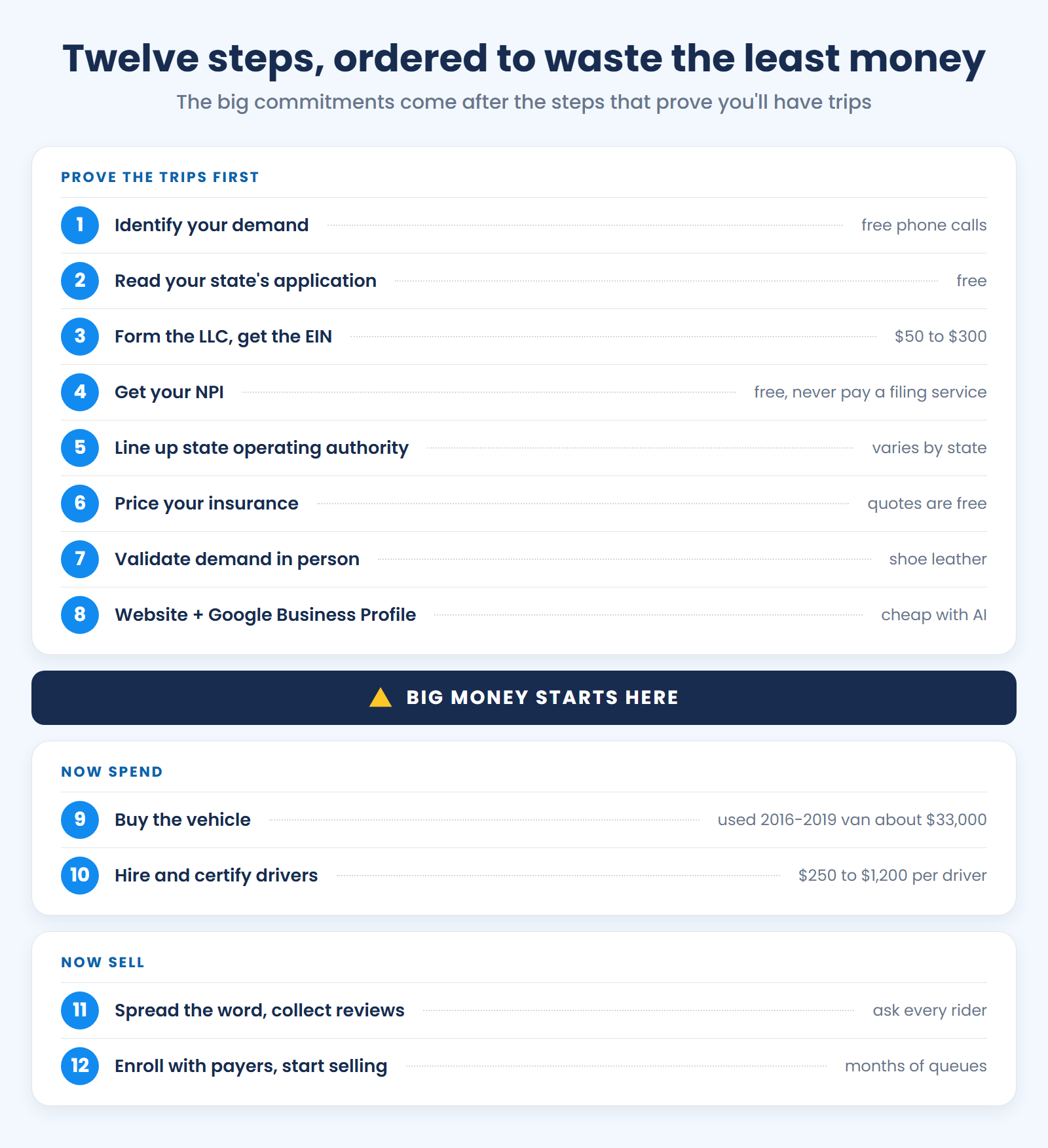
Steps 1 to 8: prove the trips first
- Identify your demand. There’s no point filing paperwork until you know where your trips will come from. Are you going after broker trips? Does your area have plenty of private-pay riders? Is your cousin a nurse whose facility is desperate for a reliable transport company? Then find out what rides cost in your town: call the transport companies and ask what they’d charge for a wheelchair trip, like a customer would.
- Read your state’s actual application. Find your state’s NEMT provider application and read it before you spend a dollar. It usually lives with the state Medicaid agency, its transportation broker, or the public service commission. It tells you the insurance minimums, vehicle rules, driver requirements, and what gets an applicant turned down. If your state’s enrollment or a broker’s letter of interest doesn’t ask for the van, file it as soon as you have the company and NPI from steps 3 and 4. The state guides below link the right one for each state we’ve covered.
- Form the business. An LLC through your Secretary of State or its equivalent, typically $50 to $300 to file (California adds an $800 annual tax for LLCs formed in 2026). Then get a free EIN, your federal tax ID, from the IRS. Takes minutes online.
- Get your NPI. An NPI is the ID number the healthcare system uses for your company. Apply on NPPES, the federal system that issues NPIs [3]: pick Type 2 (organization), and for the taxonomy code choose 343900000X, non-emergency medical transport. Texas’s Medicaid manual lists 343800000X for demand response providers instead. Your state’s application confirms the pairing. It’s free, and applying online is the fastest route, so don’t pay anyone to file it for you. You can technically skip it if you’re private-pay only, but skipping it closes broker and health-plan doors, so get it anyway.
- Line up state operating authority. Many states require a permit to carry passengers for money before you can run trips. Depending on the state, it’s called motor carrier registration, operating authority, a certificate, or a permit. Some cities and counties layer their own licenses on top, and in the DC metro the permit is regional: a regional commission, WMATC, certifies van companies’ paid trips across DC and its inner suburbs. Some states exempt small medical-transport vehicles entirely. It’s a step people often discover late, so check it now, before the vehicle.
- Price your insurance before you commit to anything. Call an agent who actually sells NEMT policies. Ask other operators who they use. Know your real premium, how much coverage the broker requires, and the down payment. Some cities and counties won’t issue your local license until insurance is active.
- Validate demand in person. Before the van, check what you found in step 1 on foot. Walk into facilities and talk to the social workers, nurses, and discharge planners who book rides. Talk to residents and their families too. Ask the broker which areas it needs more vans in. If your area already has more vans than trips, you want to know before you’re holding a $33,000 van.
- Set up your website and Google Business Profile. Build both around the trips you found in step 1. If your area needs dialysis runs, say that on the homepage. If it’s private-pay families, put the booking number front and center. You can build a site yourself with AI for very cheap, or we’ll build you a NEMT website optimized to show up on Google and ChatGPT. Add profiles on Yelp, Facebook, and the other directories too, especially if you’re skipping the brokers.
Steps 9 and 10: now spend the big money
- Buy the vehicle. Used and mechanically sound beats new debt for a first van. Match the vehicle to your customers: a spotless late-model van if you’re selling premium private pay, a workhorse if most of your trips will come from a broker.
- Hire and certify drivers, or certify yourself. Most states don’t require a CDL (commercial driver’s license) for a van designed for fewer than 16 people, counting the driver [4]. California’s line is more than 10 people, counting the driver, and every New York ambulette driver needs a CDL whatever the van’s size. Background checks are standard, and most brokers add drug testing, plus training in varying mixes: CPR, first aid, wheelchair securement, and HIPAA privacy training (the federal patient-privacy rules), even where the state doesn’t require them. Screen yourself and every driver against the OIG exclusion list and SAM.gov, the federal exclusion lists, and recheck monthly. Brokers check, and the lookup is free.
Steps 11 and 12: now sell
- Spread the word and collect reviews. Tell your family and friends, and post about the business on your personal social media. Then ask every rider for an honest Google review after each trip. Never trade a free or discounted ride for one: Google’s review policy bars offering “discounts, free goods and/or services” in exchange for a review, and it lists family ties among the conflicts of interest that can get a review removed [5]. Ten glowing reviews make it much easier to win private-pay and facility work from strangers. Your reviews are your references.
- Enroll with payers and start selling. Apply to the broker network and start calling facilities the same week. Getting approved by the broker can take months. Sell while you wait.
Should you start with broker trips, facility contracts, or private pay?
Start selling to facilities and private-pay families from day one, and treat the broker as the safety net that fills empty slots. Broker trips take the least selling and are the easiest to lose, and the operators who build entire schedules on one broker keep learning the same lesson.
Christopher Buell ran two NEMT companies and now sells facility calling to NEMT owners. In Arkansas, his company became a broker’s number one provider, and a week after the state’s human services head told him he’d made it, the broker dropped him. His rule now: give a broker about 10 percent of your time and effort, maybe 15 after a year of working together. “You’re a glorified employee of that broker,” he told me on our episode about calling facilities [6]. “You get to buy the new tires, you get to deal with the employees, but you don’t get the benefits.”
What broker trips are good for
Broker trips do have real value early:
- They generate revenue while your facility relationships grow.
- They teach you dispatching on someone else’s marketing dollar.
- In small markets, they may be most of the trips that exist.
On a 2024 industry podcast, an owner eleven years in put about 60 percent of her business in facility and private work, mostly nursing homes and a rehab hospital, and 40 percent with three brokers. The mix matters, she said, because “you’re not relying on one source all the time.” In states with several brokers, like Ohio, where each Medicaid health plan arranges its own members’ rides, some operators run four or five broker contracts so no single loss sinks the schedule. The mistake isn’t taking broker trips, even in New Jersey, where one broker arranges Medicaid rides statewide. It’s building a company where one contract you don’t control decides whether you exist.
To go after facilities, start with how to win NEMT facility contracts; for private-pay families, the private pay guide covers pricing and marketing.
Do you need a license to start a NEMT business?
There’s no national NEMT license, and most of the states our guides cover don’t issue one. Being licensed means a stack of approvals: company paperwork, any state authority to carry riders for pay, Medicaid enrollment and broker approval if you take those trips, local permits and qualified drivers.
Where states differ, it’s in how they treat the van and the trip. Virginia’s DMV certificate for NEMT carriers covers Medicaid trips only, and Minnesota requires its special transportation service certificate for rides paid with public money. Ohio requires a utilities commission certificate plus an ambulette license for paid wheelchair rides to medical care. Texas and Georgia require nothing at the state level for a typical medical-only wheelchair van, while Michigan registers paid vans by seat count. So check every layer before you buy the van: its seat count, and whether it carries wheelchairs or stretchers, can change which ones apply.
Private-pay and facility trips skip Medicaid enrollment and broker credentialing, but not your state’s authority. Our guide to NEMT business license requirements maps it for the 12 states and DC it covers, including the licenses you’ll read about that don’t exist.
Can you start a medical transportation business with one van?
Yes. Facilities and private-pay families set no fleet minimum, but some brokers and at least one county put limits on new companies. I often talk to owners who feel intimidated because they’re just starting with one vehicle and a competitor has 20. You, the owner-operator, are doing a much better quality ride and service than the 20th driver they hired.
Brokers take on new companies where they need them, and Louisiana’s Medicaid agency says its brokers don’t have to accept every company that applies. Verida, Georgia’s statewide broker, reviews applications to see whether a region needs new providers. MTM’s Rhode Island page, updated in July 2026, estimates 8 to 12 months before a new provider gets “the opportunity to become contracted,” while its Minnesota page says it’s always seeking providers. Palm Beach County, Florida, writes a two-vehicle minimum for new wheelchair and stretcher companies into its vehicle-for-hire rules. So ask the broker whether it takes a one-van company before you buy a second van just to qualify.
One van has a ceiling, too. The benchmark I give new providers: a solo-run van roughly tops out near 100 trip legs a month (a leg is one one-way ride). When you’re turning down trips every couple of days, hire a driver. Buy the second van only when the first runs close to full-time, the order Christopher Buell gave on our podcast. Our guide on how to run a NEMT business covers the stretch in between, including the day your only van is in the shop.
How long until a NEMT business is profitable?
Expect a lean first year. By the same benchmark, it takes a couple of months minimum to reach 100 trip legs a month, and an operator on our platform that was running two vans in July hit that by month four. One owner-operator (owner and driver in one) said on a 2024 industry podcast that he expected to make $25,000 to $30,000 in his first year on one van, and he made about half that. That’s what a first year can look like when you’re learning to fill a schedule.
I’ve interviewed Paul Muench, who went from zero to five vans in under a year in Phoenix. Even he says the phones “really started ringing” only after about four or five months of meeting people in the industry. NEMT scales. It just scales on systems and trip sources, not on vans bought before the trips exist. That’s also what a buyer pays for if you ever sell a NEMT business: revenue that shows up without being sold again. And the demand is coming to meet you: by 2029, adults 65 and older are projected to outnumber children in America [7].
One test before you sign for a van: write down who will pay for its first 100 trip legs a month. Which facilities, which families, which broker, by name.
NEMT requirements by state
The state guides below walk the state, broker and local layers, with the agencies, numbers, and applications linked.
More states are on the way. Need yours next? Tell us: ride@duetinc.com. And if you’re not sure who your state’s Medicaid broker even is anymore, start with who runs Medicaid rides in your state.
More guides on starting a NEMT business
Choosing the business: costs, earnings and plan
- How Much Does a NEMT Business Make? Per Van, by PayerWhat a medical transportation business makes per month, one van at a time: what each payer pays for a trip, what the van costs and what the owner keeps.
- How Much Does It Cost to Start a NEMT Business? (2026)What it costs to start a NEMT business in 2026: a line-by-line budget for one wheelchair van, state fees, insurance down payments and a free spreadsheet.
Licenses, insurance and your first van
- NEMT Vehicles: Choosing and Buying Your First Van (2026)Which NEMT van to buy first: minivan or full-size, rear or side entry, new or used, what it must pass, what it costs in 2026 and how to pay for it.
- NEMT Business License Requirements: What You Actually NeedThere's no national NEMT license. The approvals you need by state, van and payer, licenses that don't exist, what certification means and the order to apply.
- NEMT Insurance: What It Costs and What Brokers RequireWhat a NEMT company must carry, who sets the limit (state, brokers, facilities), what a new company pays per van, when to bind it, and how to lower it.
Your first trips and first year
- Building a Scalable NEMT Business from Day 1Ray and Mac came into NEMT from real estate with tight systems and a private-pay focus. Two vehicles and 45 five-star reviews later, here's how they did it.
- Why most NEMT companies struggle to scaleTe'ya Miles and James on why providers get stuck and what to fix first
- Secrets of Sustainable NEMT GrowthEugene Gindin on hiring, trip sourcing and government contracts
- From 0 to 5 vans in one yearPaul Muench on growing Gentle Turns from zero to five vans in under a year
- Succeed in NEMT servicesThe Transportation Alliance webinar with Duet cofounders on five key actions to launch or scale a successful NEMT operation across multiple states.
Growing, buying and selling
- How to Sell a NEMT Business for What It's Really WorthBusinesses selling under $2 million went for about 2 to 3 times owner earnings in mid-2026. What NEMT buyers pay for, what cuts the price, and how to prepare.
FAQ
Do I need medical training to run a NEMT company?
For ambulatory (walking) riders and wheelchair work, no. NEMT is non-emergency transportation, not medical care, and none of the states our guides cover requires EMT certification for those trips, though several require CPR and first-aid training for drivers. Stretcher service is the exception. Arizona, California, Colorado, Florida and Georgia allow non-ambulance stretcher vans for riders who need no medical care on the way, while Texas, North Carolina, Michigan and Ohio treat stretcher work as ambulance service. Confirm where your state draws that line before you build a service around it.
Does Medicare pay for NEMT rides?
Mostly no. Original Medicare covers ambulance transport when it’s medically necessary, not wheelchair-van rides to appointments. Some Medicare Advantage plans add rides as an extra benefit, sometimes a set number of one-way trips a year, arranged by the plan. The VA (Veterans Affairs) pays for a wheelchair van for eligible veterans when a VA clinician says it’s needed, usually approved before the trip. Build the business on Medicaid, facilities, and private pay, and treat Medicare Advantage trips as a bonus.
How much does Medicaid pay for a NEMT ride?
Whatever your contract or your state’s fee schedule says, so it varies by state and broker. For a 10-mile wheelchair trip, Minnesota’s fee schedule pays $39.00 in the Twin Cities metro as of October 2026, MTM’s posted Rhode Island schedule pays $41.00 for a daytime trip (rates effective July 1, 2023), and Ohio’s fee-for-service maximum for a licensed wheelchair van, unchanged since January 2024, is $44.00. A broker’s rate is often a base rate plus a per-mile rate, and the empty miles you drive to a pickup generally aren’t paid as a separate service. Know your cost per trip before you sign a rate sheet.
Requirements change and vary by state. Confirm against your state’s sources before you spend money, and treat this guide as education, not legal advice.
Sources
[1] Legal Information Institute, 42 CFR 431.53: Assurance of transportation. law.cornell.edu/cfr/text/42/431.53
[2] Duet NEMT Growth Podcast, Ep. 5: “30% margin and more: how to profitably grow an NEMT service,” with Rachel Scholler, July 2, 2025. youtube.com/watch?v=s0k6SeP3RLc
[3] NPPES, National Provider Identifier application. nppes.cms.hhs.gov
[4] Legal Information Institute, 49 CFR 383.5: Definitions (a commercial motor vehicle includes one designed to transport 16 or more passengers, including the driver). law.cornell.edu/cfr/text/49/383.5
[5] Google, Maps User Generated Content Policy Help, “Prohibited & restricted content,” accessed October 14, 2026. support.google.com/contributionpolicy/answer/7400114
[6] Duet NEMT Growth Podcast, Ep. 14: “How to CALL Facilities with Christopher Buell,” March 3, 2026. youtube.com/watch?v=MhEijJdU8ys
[7] U.S. Census Bureau, “U.S. Population Projected to Begin Declining in Second Half of Century” (release CB23-189; adults 65 and older projected to outnumber children in 2029, middle series), November 9, 2023. census.gov
About the author
James O'Donnell cofounded Duet and leads its sales, partnerships, and growth services. He talks with NEMT operators every week, hosts the NEMT Growth podcast, and answers Duet's sales line himself. More about Duet's founders →
Want more trips and less busywork?
See how Duet runs and grows NEMT businesses in a 30-minute demo.