Article
How to Start a Medical Transportation Business in Minnesota
Minnesota froze new metro NEMT providers and voted to hand its Medicaid rides to a state-hired administrator. Here's how to build anyway.
By James O'Donnell, Cofounder and COO, Duet · · Updated
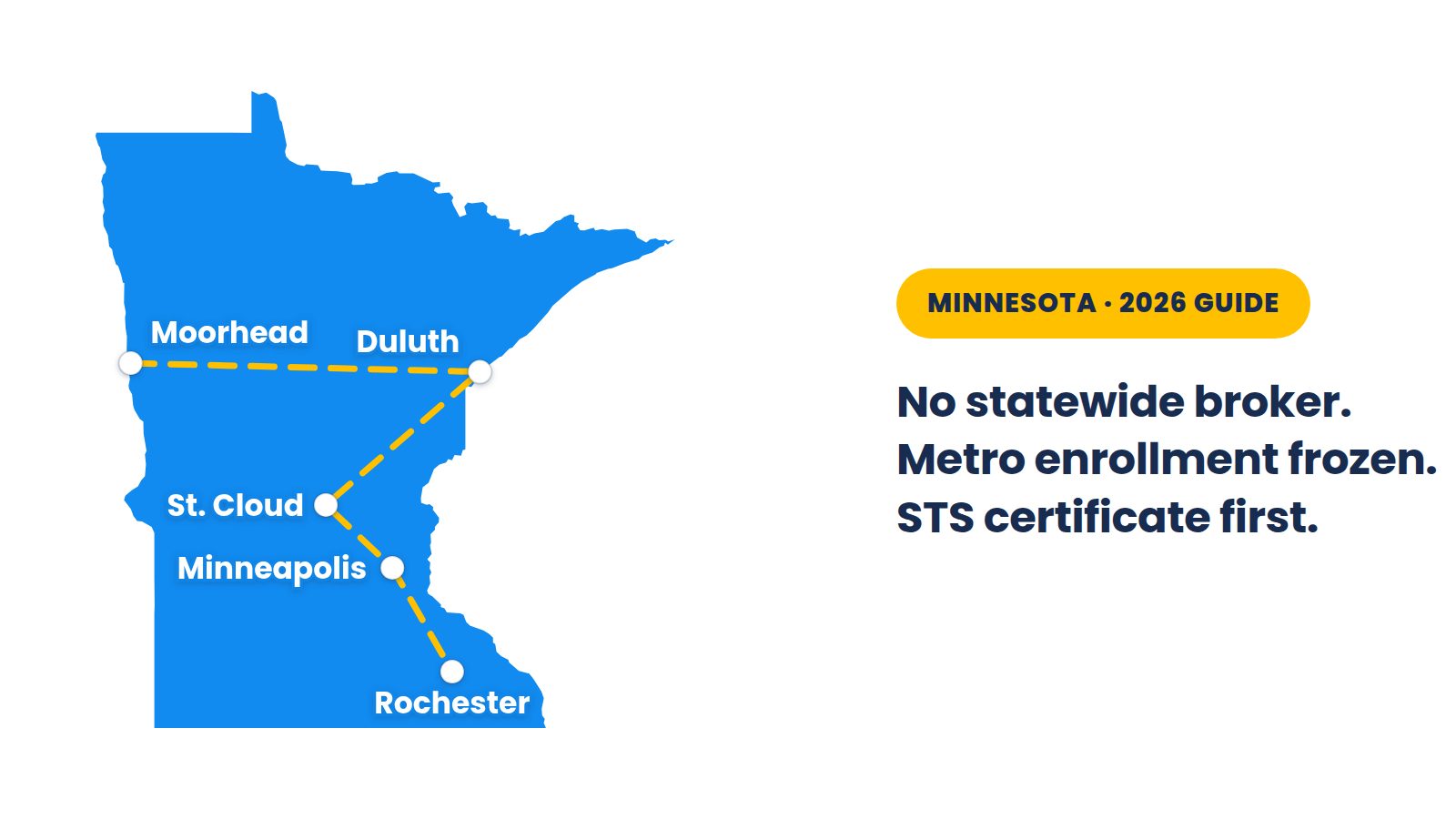
To start a non-emergency medical transportation (NEMT) business in Minnesota, form a limited liability company (LLC), earn the state’s Special Transportation Service (STS) certificate, then enroll with Medicaid. The state won’t enroll new NEMT companies located in the seven metro counties until January 27, 2027, so a metro company starts on private pay and facilities. Elsewhere, Medicaid trips take about two to six months. One used wheelchair van and six months of fixed bills cost about $25,000 to $51,000.
Minnesota at a glance:
- Enrollment freeze: DHS, the Department of Human Services, won’t enroll new NEMT companies located in Anoka, Carver, Dakota, Hennepin, Ramsey, Scott or Washington County until January 27, 2027. The other 80 counties are open.
- State license: none by that name. MnDOT, the Minnesota Department of Transportation, issues the STS certificate: background studies, $500,000 of insurance your insurer files on a Form E, an inspection, a $45 decal a van.
- Medicaid rides: no statewide broker. Counties, DHS and the health plans each run a lane.
- Enrollment: $750 in 2026, owner fingerprints, an unannounced site visit, and every driver enrolled.
- Insurance: contracts want $1 million auto and $1 million general liability, against a $500,000 state floor.
- First paid trips: private pay and facilities in four to eight weeks, anywhere in the state.
A Twin Cities owner who started in 2026 with one van told me on a demo in September that “the state of Minnesota, they are not offering any new providers.” So he was running private pay “until they open,” and he was “getting a lot of calls.” For a company in the seven metro counties, he’s right until January 27, 2027, and DHS can extend that date. A company located anywhere else in Minnesota can enroll now.
That county line decides your first year here. Inside it, the first year runs on private pay and facilities, not Medicaid. The checklist comes first, in the order that wastes the least money, then the questions in the order you’ll hit them.
I run Duet, which builds dispatch software and runs growth services for NEMT companies. This is the Minnesota edition of our national guide on how to start a NEMT business. Requirements change, so confirm against the linked sources before you spend money.
The one-page checklist: steps to start a NEMT business in Minnesota
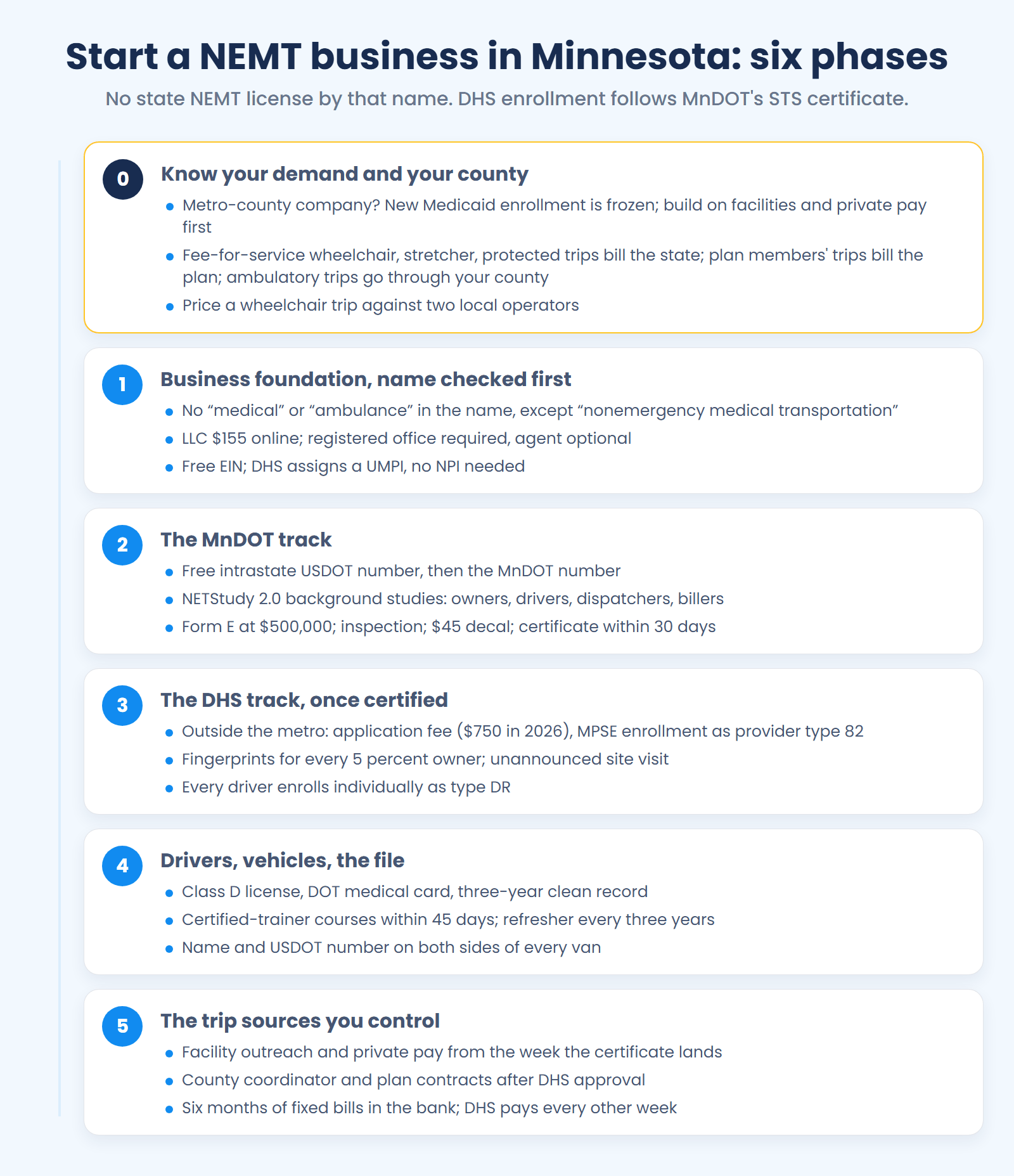
Starting a NEMT business in Minnesota takes six phases, ordered to waste the least money, and the first is free: check which side of the seven-county line you’re on.
Phase 0: know your demand and your county
The freeze follows where the company is located, so a company in a metro county can’t enroll with DHS until January 27, 2027 [1]. DHS’s notice doesn’t define “located,” so before you sign a lease, put your address to DHS in writing at transportation.DHS@state.mn.us, the contact its notice gives.
- Know who pays for what. Fee-for-service wheelchair, stretcher and protected trips bill the state. Ambulatory trips go through the county, and plan members’ trips bill the plan [2].
- Price your market. Ask two local operators what a ten-mile wheelchair trip costs.
- Meet facilities before you buy anything, and get a website that takes bookings and a Google Business Profile live.
Phase 1: business foundation, with the name checked first
Check the company name against MnDOT’s naming rule before you file anything [3].
- LLC. File with the Secretary of State: $155 online or $135 by mail, renewed free each year [4].
- Numbers. Get a free employer identification number (EIN). DHS’s NEMT enrollment needs no National Provider Identifier (NPI), because DHS assigns a unique Minnesota provider identifier (UMPI) [5][6].
- Exclusion checks. Check every owner, manager and driver against the federal and state excluded-provider lists, because Minnesota’s Medicaid program excludes anyone on either [7].
Phase 2: the MnDOT track
MnDOT’s STS certificate starts with a free intrastate U.S. Department of Transportation (USDOT) number and MnDOT’s business packet [8][9].
- Run NETStudy 2.0 background studies, $44 plus $13.50 for fingerprints, on anyone owning 5 percent or more, managers, drivers, attendants and anyone who dispatches or bills [10][11][12].
- Have your insurer file the Form E at the state’s $500,000 floor, but buy to the $1 million bars the contracts set [13][14].
- Book MnDOT’s inspection, pay $45 a decal and file the certificate packet. MnDOT answers within 30 days [15][16].
- Calendar the 90-day education deadline the day the certificate arrives [17].
Phase 3: the DHS track, once the certificate lands
Outside the metro, enroll with DHS the week the certificate lands. DHS’s application asks for the STS certificate, MnDOT’s vehicle list and proof of fingerprint-based NETStudy 2.0 studies, the same system MnDOT’s studies run through. Pay the application fee, $750 in 2026, and enroll in the Minnesota Provider Screening and Enrollment (MPSE) portal as provider type 82 [18][12].
- Screening: owner fingerprints and an unannounced site visit come before approval [19].
- Drivers: after the welcome letter, each driver enrolls as type DR [20].
- Inside the metro: skip to Phases 4 and 5. Exceptions are for areas short of capacity and need written approval from the federal Centers for Medicare and Medicaid Services (CMS) [19]. Where the 2026 law’s process applies, they also start with a county or tribal agency’s request [21].
- From January 1, 2027: owners and managers finish DHS’s compliance training before applying [21].
Phase 4: drivers, vehicles, and the file
MnDOT’s rules set the driver and van files. Each driver needs a Class D license, a three-year clean record, a federal medical examiner’s certificate and MnDOT-certified training within 45 days [22][23]. Each van needs the business name and USDOT number on both sides [24].
Phase 5: the trip sources you control
Sell facility and private-pay trips from the week the certificate lands. County and plan contracts follow DHS approval, outside the metro.
Who pays for NEMT rides in Minnesota?
Minnesota Medicaid is the volume, mostly through its health plans, and facilities and private-pay families pay for the rest of the work a new company can get.
Medicaid is the volume, and 80 percent of it sits inside the health plans
Minnesota Medicaid paid for 6.9 million NEMT trips in 2024, worth $151 million, and the health plans oversee most of it: “80% of NEMT spending is overseen by MCOs,” per DHS’s March 2026 figures to the House [25].
The statute lists seven modes, numbered 1 to 7: mileage paid to the rider or a family driver, volunteer drivers, unassisted, assisted, lift-equipped or ramp, protected and stretcher. Modes 1 through 4 are the county lane, and modes 5, 6 and 7 are state-administered and paid directly to the enrolled company [26][2].
The state’s rates as of October 2026 [27][28]:
| Mode | Base rate | Per loaded mile, from October 1, 2026 |
|---|---|---|
| Unassisted (NEMT company, not transit) | $12.10 | $1.61 |
| Assisted | $14.30 | $1.61 |
| Lift-equipped or ramp (wheelchair) | $19.80 | $1.92 |
| Protected transport | $75.00 | $2.71 |
| Stretcher | $60.00 | $2.71 |
| Extra stretcher attendant, if medically necessary | $9.00 a trip | None |
The schedule allows up to $39.00 for a ten-mile wheelchair trip when the rider’s home zip code isn’t rural. When it is rural, mileage pays 125 percent up to 17 miles and 112.5 percent from 18 to 50, and a super-rural zip adds 11.3 percent to the base [26]. Mileage carries a quarterly fuel adjustment whenever Minnesota gas tops $3 a gallon, so check the schedule again after January 1, 2027 [26].
The state’s fee-for-service rate doesn’t pay for the drive to the pickup. “NEMT providers cannot bill for ‘no load’ miles,” DHS told the House, and its manual pays nothing extra for waiting or no-shows [25][29]. One county-based plan, South Country, does pay its contracted providers for unloaded miles to the pickup and for waits past the first hour [30].
The health plans set their own rates
Minnesota’s health plans set transportation rates by contract, and the statute’s rate table doesn’t bind them [26]. None of the plans’ public pages lists a transportation rate, so ask for the rate sheet and the pay schedule before you sign.
Facilities are the stability
Facilities give a new company work it doesn’t have to win one rider at a time, and Minnesota has 338 nursing facilities with 24,057 certified beds in CMS’s September 2026 file [31]. Our guide to winning facility contracts covers how to get in.
CMS also counts 113 dialysis facilities in 50 of the state’s 87 counties [32]. In my experience most dialysis riders are on Medicaid, though, so their trips come through the county, the plans or the state’s wheelchair lane, not the clinic.
Private pay is the margin
One Winona County company posts $30 plus $2.49 a mile for a wheelchair trip, as of October 2026, which comes to $54.90 for ten miles [33]. That’s against the schedule’s non-rural $39.00 for the same trip. That gap is why I tell new owners to start with pricing private pay before they chase a Medicaid contract.
Another Twin Cities owner-operator, running a van or two, told me on a June demo that about 80 percent of his rides were private pay. He planned to drop Medicaid, which by his count paid about a third of his private rate. By October, on an operator call I sat in on, he’d borrowed a wait-and-return offer from another operator’s website for his own. Google Ads brought him two or three riders for it. One was a colonoscopy trip: he picked the rider up around 7 AM and waited about three hours, at “$100 per hour, no hidden fees.”
Price the wait as its own product, by the hour. And know what a Google Ads caller costs before you buy clicks.
Where the riders live
The seven-county metro holds 55 percent of Minnesotans and half of those 65 and older, so the freeze covers the biggest market [34]. Among counties of 20,000 or more, the five where the 65-and-over population grew fastest from 2020 to 2024 ring the metro: Carver and Scott inside the freeze, and Wright, Chisago and Sherburne just outside it [34].
The smaller lane: waiver transportation
Minnesota’s home and community-based waivers pay separately for non-medical rides, on the same STS certificate plus a separate DHS waiver enrollment [35][36]. DHS’s October 2026 limits put an Elderly Waiver or Alternative Care one-way trip at $20.21 plus $1.54 a mile [37]. It’s a separate product by statute, and DHS’s notices don’t say whether it will enroll a metro company for it during the freeze, so ask before you count on it [36].
Who is the NEMT broker in Minnesota?
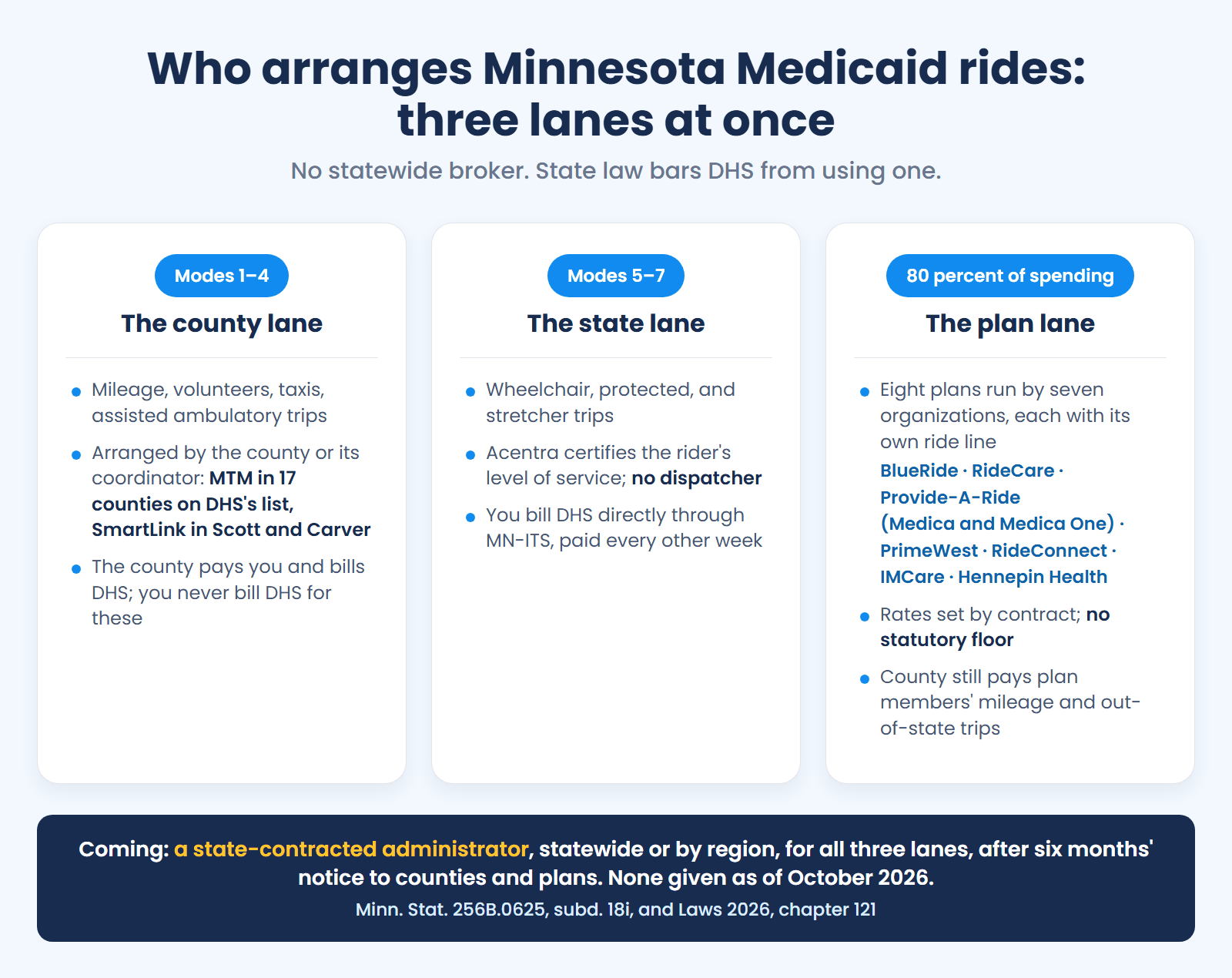
Nobody is Minnesota’s statewide NEMT broker: state law bars DHS from using one, so counties, DHS and the health plans each arrange part of the rides. Minn. Stat. 256B.0625, subdivision 18b, has said so since 2009: “Except for establishing level of service process, the commissioner shall not use a broker or coordinator for any purpose related to nonemergency medical transportation services” [26].
Counties arrange ambulatory trips, DHS pays fee-for-service wheelchair, stretcher and protected trips with no dispatcher in between, and each health plan runs its own ride line [2]. Our guide to how NEMT brokers work covers the states that use them.
Where MTM fits, and where it doesn’t
MTM Health works for Minnesota counties, not the state. Its Minnesota page says it coordinates fee-for-service Medical Assistance rides “in the Metro Twin City area through a contract with the Metro County Consortium” [38].
DHS’s manual lists 13 counties under Hennepin County’s contract: Anoka, Benton, Chisago, Dakota, Hennepin, Isanti, Mille Lacs, Pine, Ramsey, Sherburne, Stearns, Washington and Wright. Four more sit under St. Louis County’s: Aitkin, Carlton, Lake and St. Louis. SmartLink, the Scott and Carver mobility office, covers those two [39][40]. The other 68 counties run the lane through their human services offices or a hired coordinator, much as Ohio’s counties do.
To get in, DHS tells providers to “contact MTM-MNET, SmartLink or the local county or tribal agency” [39].
Which plan runs which ride line
Every Minnesota health plan books its own members’ rides, and none of the plans’ pages names an outside broker. The county still pays a plan member’s mileage reimbursement and any out-of-state trip the plan approves [2]. The plans’ ride lines, as of October 2026:
| Plan | Ride line | Notice the rider gives |
|---|---|---|
| Blue Plus | BlueRide | 5 business days by online form, or call with less [41] |
| HealthPartners | RideCare | 3 to 5 days, 5 to 7 with mobility help [42] |
| Medica and Medica One Health Plan | Provide-A-Ride | 5 days [43] |
| Hennepin Health | Member Services | 3 days [44] |
| PrimeWest Health | Transportation Contact Center | 2 business days [45] |
| South Country Health Alliance | RideConnect | 3 business days [46] |
| IMCare | Member Services | 3 days, up to 5 for public transit [47] |
UCare’s Medicaid plans moved to Medica on October 1, 2026 and now run as Medica One Health Plan [48][49]. UCare itself is in court-ordered rehabilitation [50].
The administrator that’s coming, on a date nobody has set
A state-hired administrator, or several by region, is coming for all of Minnesota’s Medicaid rides, and as of October 22, 2026, it has no start date. The 2025 law orders DHS to “contract either statewide or regionally for the administration of the nonemergency medical transportation program” [51].
The 2026 law tied the switchover to the administrator’s implementation. That’s the day the county lane, the statutory rate table and the broker ban end, and DHS owes counties and plans six months’ notice first [21]. As of October 22, 2026, DHS’s provider news, its manual and the revisor’s statute page show no notice and no award [52][53].
When it starts, the county lane and the plans’ own ride lines give way to it, so the contracts you sign now won’t carry over on their own. Minnesota could then look like Georgia under Verida or Colorado under MediDrive, and our broker tracker will carry the notice when DHS gives it.
Is there a moratorium on new NEMT providers in Minnesota?
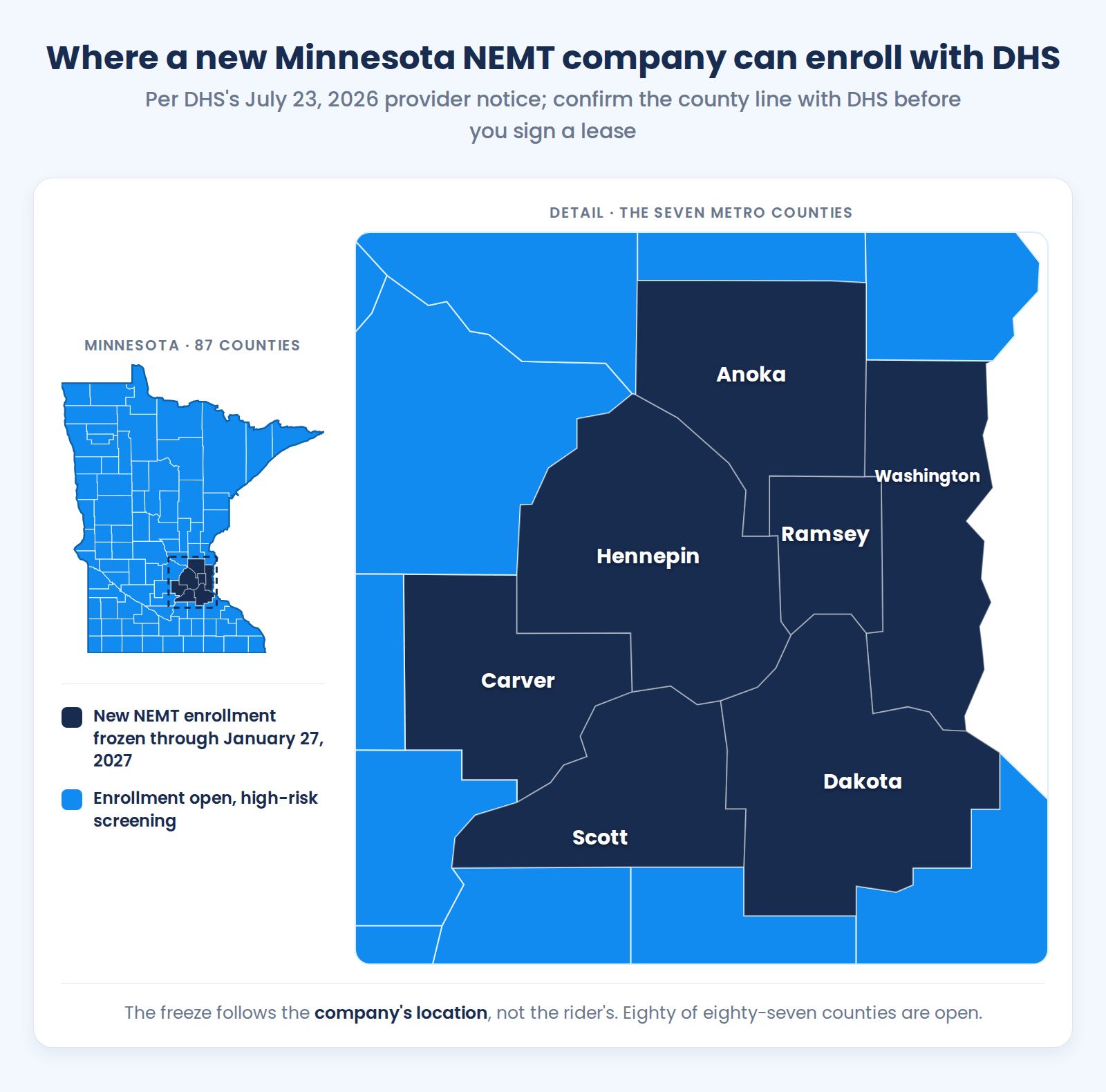
Minnesota has a moratorium on new NEMT providers, but only for companies located in the seven metro counties. DHS won’t enroll them until January 27, 2027, and companies located anywhere else in the state can enroll.
DHS’s July 23, 2026 notice covers providers “located in the seven-county metro area.” The moratorium, “effective beginning Jan. 27, 2026, is now extended to Jan. 27, 2027,” and “NEMT providers located in any Minnesota county that is outside the seven-county metro area can enroll” [1]. The same notice still runs, unchanged, in DHS’s October 2026 provider news [52].
DHS hasn’t published a final end date. The freeze began at CMS’s direction [54], and DHS’s July 10 notice on its broader high-risk freeze, which doesn’t say whether NEMT is part of it, says DHS “may extend it if necessary” [52]. And if the 2026 law’s 24-month limit governs this freeze, it could run to January 2028 [21].
What the freeze means for a metro company
The freeze follows the company’s location, not the rider’s, so a metro company gets no county, state or plan NEMT trips until it lifts. The plans can’t take you, because federal rules require the state to screen and enroll every provider in a Medicaid plan’s network, and DHS enrolls plan-network-only providers on its own agreement form [55][12]. The county lane is closed too: its claims carry each driver’s DHS enrollment number, and drivers enroll through an enrolled company [2][56][20][39].
DHS’s January release on the freeze said enrolled providers could add locations for services they already provide [54]. The July 23 notice doesn’t say whether that still holds for a metro location, or how DHS treats a second company with a metro owner. Ask in writing before you plan on either. The application fee is nonrefundable, so don’t pay it until DHS can enroll you, and by then it won’t be 2026’s $750 [57][18]. What’s open on day one is private pay and facility work. When the owner at the top of this guide told me about the freeze, I told him I know people who have built a whole business in Minnesota “just on private pay.”
How Minnesota got here
Minnesota got here through a year of federal and state fraud enforcement aimed at 14 high-risk Medicaid services, NEMT among them [19]. DHS’s revalidation drive sent disenrollment notices to 3,411 of 5,583 high-risk providers of all types, most over incomplete paperwork [58][59]. And $533.2 million of deferred federal Medicaid money is in dispute, with a court-ordered stay giving the state and CMS until January 4, 2027 to settle it [60].
What a 2026 entrant inherits
A company enrolling now inherits four rules.
- High-risk screening. Owner fingerprints and an unannounced site visit before enrollment, then revalidation with a site visit at least every three years [19][21].
- A possible 90-day withhold. The 2026 law says DHS “may withhold” a new high-risk provider’s first 90 days of claims. DHS’s provider news hadn’t said by October 2026 whether it does for NEMT [52], so plan as if it will [21].
- Electronic visit verification (EVV). NEMT joins it January 1, 2027 or on federal approval, whichever is later [21], and DHS hadn’t published NEMT instructions as of October 2026 [52][61].
- A five-year bar. A terminated NEMT provider and everyone named on its disclosure form can’t re-enroll for five years [26].
Clean files are the entry ticket.
Can I bill Minnesota Medicaid directly for NEMT rides?
Yes, Minnesota Medicaid pays enrolled companies directly for fee-for-service wheelchair, stretcher and protected trips, but never for ambulatory trips, which the county lane pays. DHS’s bulletin to the counties says state-administered trips are “reimbursed directly” to the enrolled provider, while county-lane providers don’t bill DHS for theirs [2]. A health plan member’s trip bills the plan. For comparison, Arizona keeps a permanent direct lane, and North Carolina runs its lane through county social services.
How the wheelchair lane works
The wheelchair lane works without a dispatcher: a state reviewer certifies the rider, the rider calls an enrolled company, and the company bills DHS. Acentra Health, DHS’s medical review agent, certifies riders for assisted, wheelchair and stretcher trips, in ten days for a request it holds for review and 72 hours for an expedited one [62]. Nursing facility residents skip that review for every trip but stretcher [63].
You bill on an 837P, the standard electronic claim, through MN-ITS, DHS’s online claims system, with the driver’s UMPI as the rendering provider [29][26][56]. DHS pays clean claims every other week on its published calendar [64]. NEMT claims also get extra review before payment, DHS told the House, and DHS has said some claims under that review can be held up to 90 days [25][19].
The trip record that decides whether you keep the money
Minnesota makes the trip record “a condition for payment”: subdivision 17b of the NEMT statute lists 14 elements every record must carry [26].
- The rider’s name and the date of service.
- The driver’s printed name or provider number, and a dated signature attesting to “the actual miles driven.”
- The rider’s dated signature, the medical provider’s certification of arrival, or a note that signatures were requested.
- Origin and destination addresses, the most-direct-route mileage and how you set the route.
- The mode and the license plate.
- Pickup and drop-off times, with the odometer reading at each.
- The attendant’s name, if one rode.
Money paid on undocumented trips “may be subject to recovery,” and the standard reaches audit findings back to January 1, 2020 [26]. DHS wants records kept at least five years, so keep every trip record that long [7].
The ambulatory lane, and why it pays through the county
Ambulatory trips pay through the county lane: providers there bill the county or its coordinator, never DHS [39]. Each county sets its own billing deadlines and pay timing, and it pays the lesser of your charge and the amount DHS allows. MTM sets rates with each provider and “does not reimburse transportation providers for no shows” [14]. Since August 1, 2026, a county or coordinator’s claim for your trip must carry your company’s NPI or UMPI as the referring provider [56]. Ask the county what it pays, and when, before you build an ambulatory book.
What licenses and requirements does a NEMT business need in Minnesota?
Minnesota has no license called a NEMT license: MnDOT’s Special Transportation Service (STS) certificate, under Minn. Stat. 174.30 and Minnesota Rules chapter 8840, is the operating authority for rides paid with public money [65][66]. For Medicaid work, subdivision 17 of the NEMT statute adds two lines: “All nonemergency medical transportation providers must comply with the operating standards for special transportation service,” and “all drivers must be individually enrolled with the commissioner” [26].
The claims you’ll read elsewhere, against the sources
These ten claims about Minnesota NEMT turn up in search results and AI answers as of October 2026, and each is wrong or out of date for Minnesota.
| The claim you’ll read elsewhere | What Minnesota actually requires |
|---|---|
| ”Minnesota utilizes regional brokers to manage and dispatch non-emergency medical rides for Medical Assistance and MinnesotaCare beneficiaries.” | No statewide or regional broker works for the state, which the law bars from using one [26]. Counties, DHS and the plans each arrange their own rides. |
| ”Minnesota is the one state that bans broker dispatching outright” / “There is no broker in the payment path.” | The ban binds DHS, not counties. MTM coordinates the county lane for two county groups, and those trips pay through the coordinator [39]. |
| ”Local business licenses” / “Licensing requirements vary by state and county.” | An STS certificate holder needs no other state or local permit for those vans [65]. Minneapolis’s own permit and the airport’s are the questions to ask. |
| Drivers’ “mandatory training, which often includes CPR” | The state rule requires four hours of first aid and no CPR (cardiopulmonary resuscitation) course or drug test [23]. Contracts may add both. |
| ”state and broker minimum liability limits (typically a $1,000,000 commercial auto liability policy)“ | The state minimum is $500,000 combined single limit per vehicle [13]. The $1 million is a contract bar. |
| ”Estimated Annual NEMT Expense: $38 million” and “1,615,880” trips | Those are a 2018 national research report’s estimates, not DHS figures. DHS reported $151.4 million and 6.9 million trips for 2024 [25]. |
| ”House File 36 would raise the lift-equipped base rate to $31.00” and today’s rate is “$19.80 base rate and $1.70 per mile” | H.F. 36 was laid over in committee in February 2025 and never moved again [67][68]. The state’s schedule allows $19.80 plus $1.92 a loaded mile from October 1, 2026 [27]. |
| ”Apply for a Type 2 NPI number required for healthcare and transportation billing.” | DHS’s NEMT enrollment doesn’t require an NPI. DHS assigns a UMPI [5]. |
| ”Beginning July 1, 2026, for fee-for-service, and January 1, 2027, for managed care, NEMT will be moving to a single administrator” | The 2026 law tied the switch to the administrator’s implementation, after six months’ notice to counties and plans [21]. None had been given as of October 2026. |
| Step lists that never mention the freeze | New NEMT companies located in the seven metro counties can’t enroll until January 27, 2027 [1]. |
Who needs the STS certificate
The STS certificate is required of any company that carries elderly or disabled riders “on a regular basis,” meaning more than 12 round trips or 30 passengers a month, with public money in the fare. Public money includes Medicaid dollars passed through a county or a health plan, and a facility, a Medicare Advantage plan or the VA paying with public program money [65][69]. A company paid only by its riders sits outside the standards on the statute’s face. Don’t build on that reading. I’d get the certificate anyway.
What the certificate takes
The certificate takes the Phase 2 steps, then one more that quietly kills new certificates [9]. Within 90 days of the effective date, someone with substantial interest or control must finish MnDOT’s initial provider education, or “the certificate of compliance is deemed canceled upon expiration of the 90 days” [17].
Carrying a passenger who might reasonably need an ambulance draws a penalty of up to $10,000 under Minn. Stat. 174.315 [70].
The naming rule, and the one phrase it allows
MnDOT’s naming rule keeps “medical,” “emergency,” “life support,” “ambulance” or anything suggesting ambulance service out of your name and ads unless you hold an ambulance license [3]. The statute allows one phrase: a provider “may use the phrase ‘nonemergency medical transportation’ in its name” [65].
The local layer, and the Minneapolis question
Minnesota’s STS certificate preempts local permits: under Minn. Stat. 174.30, subdivision 6, a holder “is not required to obtain any other state or local permit, license or certificate as a condition of operating the vehicles for that purpose” [65].
Minneapolis is the one to call. Its taxicab chapter has a “medical contract transport” permit for prearranged, flat-fare trips between a patient’s home and a contracting medical facility, listed at $1,050 on the city’s 2026 fee schedule [71][72]. Its taxicab chapter never mentions STS, so ask Minneapolis Business Licenses (612-673-2080) whether the permit reaches a certified van, and get the answer in writing.
Pickups at the Minneapolis-St. Paul airport carry their own permit and per-trip fees, with no medical exemption, so call the Metropolitan Airports Commission’s Landside office (612-726-5463) before you promise an airport run [73].
Sedans are no shortcut. The statute puts taxis inside the STS definition, and a private-pay sedan company without the certificate likely falls under city taxi rules, such as Saint Paul’s $469 a vehicle and $51 a driver [74][75].
What are the NEMT insurance requirements in Minnesota?
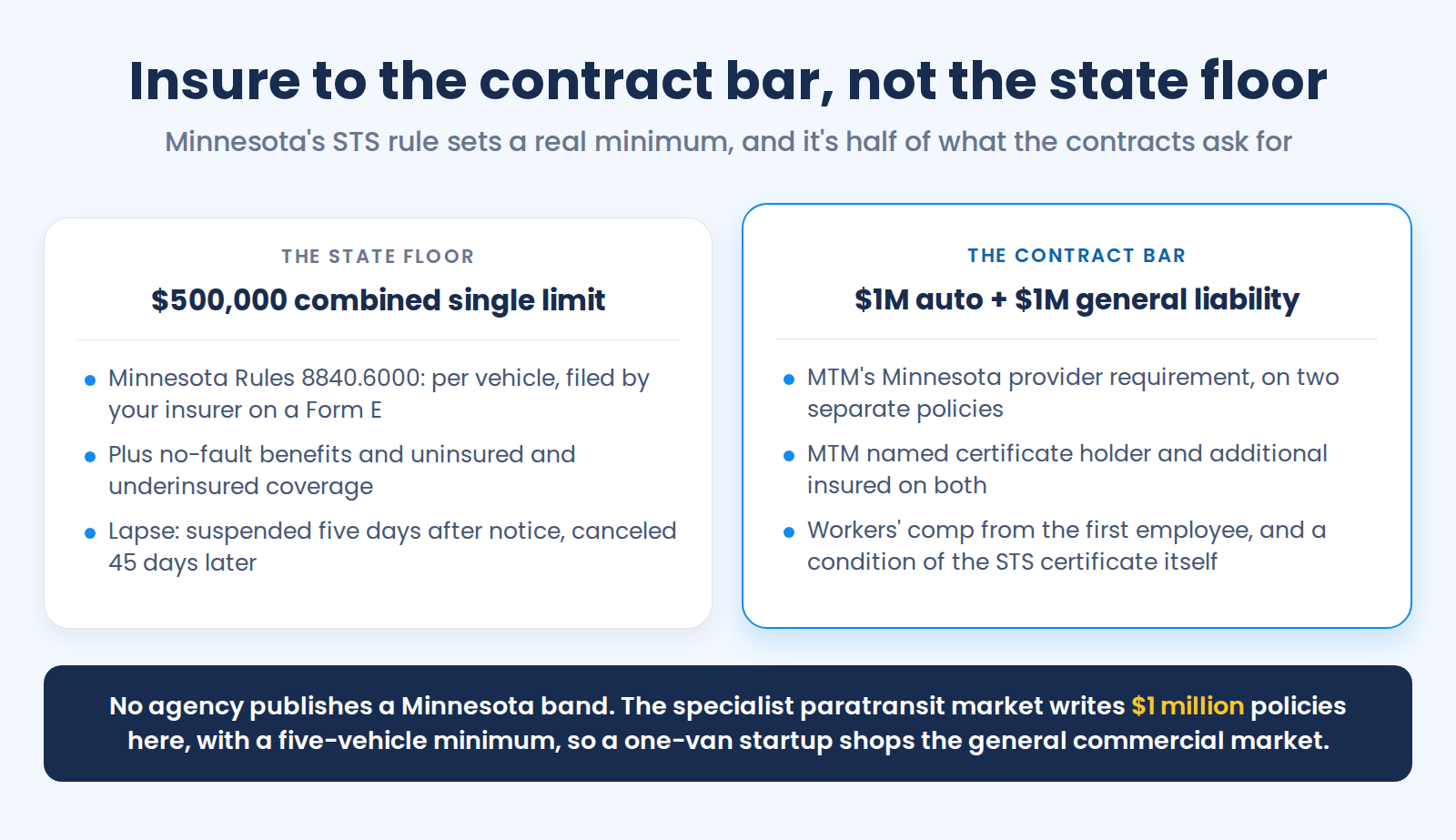
Insure to the contract bars, not the state floor. MTM’s contract expects $1 million of commercial auto liability and $1 million of general liability, while MnDOT’s rule sets a $500,000 combined single limit per vehicle, filed by your insurer on a Form E [14][13].
The contract bar: $1 million, on two policies
MTM Health requires “general and automobile liability policies of no less than $1,000,000 each,” with MTM listed as “a Certificate Holder and Additional Insured” on both, plus workers’ comp [14]. Blue Cross asks for $1 million of combined single limit auto liability before it contracts a transportation company [76].
The state floor: $500,000 a vehicle, filed by your insurer
Minnesota Rules 8840.6000 sets the state floor “for each vehicle”: Minnesota no-fault benefits, “residual liability coverage in the amount of $500,000 combined single limit,” and uninsured and underinsured motorist coverage [13]. If the policy lapses, MnDOT suspends the certificate five days after mailing you notice, and you have 45 days to cure it before cancellation [77].
What it costs
Insurance for one wheelchair van runs about $14,400 to $21,600 in a new company’s first year, or $1,200 to $1,800 a month, going by operators’ quotes from 2024 to 2026. That’s our national figure for what new operators pay, since no licensed agency publishes a Minnesota band. A specialist paratransit program that writes in Minnesota wants “Three years in business” and a “Minimum five units,” so a one-van startup shops the general commercial market [78]. Get three quotes, and ask each agent whether the carrier will sign the Form E.
Workers’ comp is part of the STS application
Workers’ comp is part of the STS application, and state law requires it from the first employee [79][80]. An LLC manager who owns at least 25 percent of a company with ten or fewer members and under 22,880 payroll hours a year is excluded [81]. That fits most owners driving their own van. Minnesota’s misclassification law judges a driver by the comp and unemployment tests, not the contract [82]. I’d run W-2 drivers.
The 2026 and 2027 labor rules a one-van company meets
A one-van company with a hired driver meets three Minnesota labor rules on top of payroll taxes, and the wage floor rises in 2027.
- Paid Leave: 0.88 percent of wages in 2026 and 2027, or 0.66 percent for an employer with 30 or fewer employees. Employers may deduct up to 0.44 percent from paychecks, so a small employer’s own share can be as little as 0.22 percent [83][84].
- Minimum wage: $11.41 statewide in 2026 and $11.87 from January 1, 2027 [85][86]. Minneapolis is $16.37 for every employer in 2026 and $17.02 from January 1, 2027 [87]. Saint Paul’s rate for five or fewer employees is $14.25 until July 1, 2027, then $15.00 [88].
- Workers’ comp: in the 2026 assigned-risk plan, the driver classes a NEMT company could land in run from $5.52 to $8.20 per $100 of payroll, a swing of almost 50 percent the rating bureau decides, so ask your agent which class you’ll be in [89]. New rates arrive each January 1.
What do NEMT drivers need in Minnesota?
NEMT drivers in Minnesota don’t need a commercial driver’s license (CDL) for a wheelchair van. A regular Class D license covers vehicles designed for 15 or fewer passengers counting the driver, up to 26,000 pounds [90][91]. They do need three layers of paperwork: a DHS enrollment for Medicaid trips, MnDOT’s driver file and MnDOT’s training.
Layer one: the DHS enrollment
For Medicaid work, every driver enrolls with DHS individually and goes on each claim as the person who drove [26]. After your company’s welcome letter, each driver enrolls as type DR through your MPSE portfolio and signs DHS’s driver agreement, DHS-4611A [6][20]. Each needs a fingerprint-based NETStudy 2.0 study first, and a driver off your roster more than 180 days needs a new one [92].
Layer two: MnDOT’s driver file
MnDOT’s driver file, under Minnesota Rules 8840.5900, holds four things [22]:
- Age 18 or older, with a license for the vehicle’s class.
- A clean three-year record: no cancellation, revocation or listed suspension, no conviction for driving without a valid license, and no impaired-driving conviction or alcohol-related revocation.
- A federal medical examiner’s certificate, carried while driving.
- The driving record pulled before hire and every year, and the background study cleared before the first shift.
Layer three: the training, in person, with tests
MnDOT’s training comes in three tiers under Minnesota Rules 8840.5910, taught in person with proficiency tests unless MnDOT approves otherwise [23]:
- Before the first passenger, from you: orientation, a lift, ramp and securement demonstration, emergency procedures, the daily inspection and a behind-the-wheel check.
- Within 45 days, from a MnDOT-certified trainer: four hours each of first aid, abuse prevention and defensive driving, plus eight hours of passenger assistance for wheelchair work.
- Every three years, a 15-hour refresher.
The background study reaches the office
Minnesota’s background study reaches the office, not just the van. Minn. Stat. 174.30, subdivision 10, covers employees who “perform any scheduling or dispatching tasks” or “perform any billing activities” [65]. Your dispatcher and your biller get fingerprinted.
What plans add, and what the van carries
Health plans can add to the driver file. PrimeWest asks for “additional driver and attendant training for protected transportation services” [93]. Drug tests and CPR, where a contract asks for them, come from the contract, not the state rules, so build each file to the strictest contract you hold [23]. The van needs a logged daily safety inspection [94] and an approved securement device at every wheelchair position, inspected every year [95].
Can a NEMT company run stretcher van trips in Minnesota?
Yes, a NEMT company can run stretcher van trips in Minnesota for riders who aren’t likely to need medical treatment on the way. The state’s ambulance definition leaves those trips to the STS certificate. Minn. Stat. 144E.001, subdivision 3, counts as ambulance service “all transportation involving the use of a stretcher, unless the person to be transported is not likely to require medical treatment during the course of transport” [96].
What Medicaid pays for a stretcher trip
Minnesota Medicaid pays $60 plus $2.71 a loaded mile for a stretcher trip as of October 2026, plus $9 for an extra attendant “if deemed medically necessary” [27][26]. The $60 base hasn’t moved since 2005. Every stretcher trip needs the review agent’s certification first, nursing facility residents included [63]. No statute or rule requires a second person, but drivers need “a minimum of two hours” of stretcher training [23].
What families and hospices pay
Families, hospices and hospitals pay for private stretcher trips, and in one operator’s case far more than Medicaid’s base. A Twin Cities stretcher operator with two or three vans told me on a demo in April that his trips start at $500. “It’s either a family pay or the hospice pays or the hospital pays,” he said. “We rarely invoice insurance.” To him, it’s “better than a $1,500, $2,000 ambulance ride.”
The line is treatment, and offering counts
The line between a stretcher van and an ambulance is treatment. The trip becomes ambulance service when the rider is likely to need “medical treatment during the course of transport,” or when treatment is “rendered or offered to be rendered” [96]. In practice, giving oxygen, running an intravenous line or clinical monitoring is treatment, while securing a rider’s own oxygen tank isn’t [23]. Write the no-care line into your dispatch protocols, and get the state Office of Emergency Medical Services’ reading in writing before your first hospice contract.
Protected transport, Minnesota’s behavioral-health mode
Protected transport is Minnesota’s behavioral-health mode, for a rider whose prescreening “has deemed other forms of transportation inappropriate” [26]. The vehicle has “safety locks, a video recorder, and a transparent thermoplastic partition between the passenger and the vehicle driver.” A mental health crisis team, or a hospital practitioner for a stabilized hospital-to-facility trip under 100 miles, certifies each rider for a single trip on DHS form 6715. Every driver and attendant needs six hours of de-escalation training [97][98].
Protected transport pays $75 plus $2.71 a loaded mile from October 1, 2026 [28]. DHS adds: “Protected transport requires a driver and an attendant be in the vehicle during each transport,” except for a rider stabilized in an emergency department on a trip under 100 miles [98].
How do you become a Minnesota Medicaid NEMT provider?
To become a Minnesota Medicaid NEMT provider, earn MnDOT’s certificate, enroll with DHS the week it lands, then sign the county and plan contracts. MnDOT’s provider page lists Medicaid enrollment among its steps, but DHS’s enrollment page asks for the STS certificate and MnDOT’s vehicle list, so the certificate comes first [9][12].
Step one: the MnDOT certificate
You need the MnDOT number from the business packet to start the background studies, and MnDOT decides within 30 days of a complete application [92][16].
Step two: DHS enrollment, outside the metro
DHS enrollment outside the metro starts with the $750 fee for 2026. File in MPSE as provider type 82, specialty 89, with the STS certificate, the vehicle list, a provider agreement (DHS-4138, or DHS-8355 for plan-network-only work) and the ownership disclosure, DHS-5259 [5][12].
Step three: the county and plan contracts
The county and plan contracts come after DHS approval. For ambulatory work, apply to MTM’s network, SmartLink or your county [99][39]. Each health plan has its own agreement. Blue Cross’s typically takes 60 days once a request is approved, and a review “does not guarantee that you will be offered a contract” [76].
How long the two tracks take
Outside the metro, plan on about two to six months from the start to a first Medicaid trip. The certificate takes four to eight weeks. Then DHS allows 30 days to process an enrollment, plus up to 60 more for its site visit, and each corrected submission restarts the 30 days [12]. Each driver’s enrollment can take up to 30 days after that [20], and a request for more information gives you 60 days to answer [57]. Inside the metro, the clock waits on the freeze. For the national picture, see how enrollment works in other states.
Start with the payer the freeze can’t reach
Private-pay families and facilities are the payers the freeze can’t reach, because neither one checks whether DHS is enrolling. The certificate arrives and the van can carry those riders that week. With a facility that already has a provider, ask to be the backup for Sundays and after hours, take the two trips nobody else wants, and be early both times. That’s how a first facility meeting becomes a first trip.
Don’t build the whole schedule on one payer
Minnesota spent 2026 showing why one payer is a risk: a metro enrollment freeze, 3,411 disenrollment notices and a health plan in court-ordered rehabilitation. And the coming state administrator will take over the county and plan lanes after six months’ notice to counties and plans, while the law requires no notice to providers.
A rural owner, stuck in limbo
A rural Minnesota owner told me on a demo in September that his company had been established for a year and a half, and that he was “kind of stuck in limbo.” He was pursuing a contract with one of two health plans “rather than just kind of whoever calls me,” and he didn’t know when he’d “actually start driving and getting rides.”
That isn’t an argument against Medicaid work. It’s an argument against a schedule that waits on one payer. Outside the metro, private pay, facilities and the state’s own wheelchair lane don’t wait on any plan.
The hedges Minnesota hands you
Minnesota hands a new company four hedges against one payer.
- The state’s wheelchair lane bills DHS directly, with no broker to drop you, until the administrator arrives [2].
- Facilities, starting with 338 nursing facilities [31].
- Private pay, where waits earn by the hour, as the owner-operator with the $100-an-hour wait found.
- Greater Minnesota, where enrollment is open. Mayo Clinic drew about 139,000 patients from outside its home county in 2024 into Rochester, a city of 124,000 [100][101].
Why I still push private pay first
On demos I push private pay and facility work first, and the math is why. A $1,200 to $1,800 monthly insurance bill takes about 31 to 47 ten-mile wheelchair trips at the $39.00 the schedule allows for a non-rural trip, and about 22 to 33 at the Winona County card’s $54.90. Run the numbers on what a wheelchair van earns in your own market. Medicaid still counts here: Minnesota Medicaid paid for 6.9 million trips in 2024, the state pays fee-for-service wheelchair work directly on a two-week cycle for clean claims, and outside the metro the door is open [25][64].
Whatever mix you land on, keep it in one system: Duet puts broker trips and trip spreadsheets on the same board as your facility and private-pay trips. You still sign each county and plan contract and keep the 14-element trip record.
How much does it cost to start a NEMT business in Minnesota?
One used wheelchair van and six months of fixed bills cost about $25,000 to $51,000 in Minnesota, if you drive it yourself. Say you buy either an older $24,000 van with 20 percent down, financed at 14 percent over five years, or a $33,000 van from 2016 to 2019 outright, and insure it at $17,400 a year, a quarter at signing and the rest in monthly installments:
| Launch cost | Older van, financed | 2016-2019 van, bought outright |
|---|---|---|
| Van, or its down payment | $4,800 | $33,000 |
| State fees | $1,008 | $1,008 |
| Tax, title and registration, about 7 percent | $1,680 | $2,310 |
| Equipment, lettering, training, phone and marketing | $2,300 | $2,300 |
| Insurance due at signing, a quarter of the year | $4,350 | $4,350 |
| Six monthly insurance installments, van payments and phone | $10,602 | $7,920 |
| Total | $24,740 | $50,888 |
A $40,000 van in cash makes it about $58,000. Fuel and wages aren’t in these totals.
A metro company that can’t apply yet skips the application fee for now. Hire a driver at Minneapolis’s 2027 minimum wage, and 173 hours a month comes to about $2,950, or about $2,050 at the statewide $11.87. With payroll costs, fuel, the van payment, software and insurance, a Minneapolis van then burns about $5,500 to $6,500 a month until trips cover it. Our national startup costs use the same model.
What each line costs
The line items below are Minnesota’s launch costs as of October 2026, $0 rows included.
| Line item | What it costs |
|---|---|
| LLC formation | $155 online, $135 by mail, free renewal [4] |
| Registered agent | $0. Minnesota requires a registered office and only “may” have an agent [102] |
| Assumed name, if you use one | $50 online, plus newspaper publication in two issues [103] |
| EIN | Free |
| NPI | Free, and not required for the DHS enrollment [5] |
| State NEMT license | $0. None exists |
| USDOT number, intrastate | $0 [8] |
| MnDOT STS certificate | No published application fee, and $45 a van a year for the decal [15] |
| Background studies | $44 plus $13.50 for fingerprints each, about $345 for six people [10][11] |
| Federal medical examiner’s certificate | Clinic-priced, per driver |
| MnDOT-certified driver training | Trainer-priced |
| DHS enrollment | $750 for applications filed in 2026. CMS usually announces the next year’s fee in December [18] |
| City permits | $0 for an STS van under state preemption [65]. Minneapolis lists its medical contract transport permit at $1,050 for 2026, if it applies [72] |
| Commercial auto and general liability | About $14,400 to $21,600 a year for a new company’s wheelchair van, roughly a quarter due at signing |
| Used wheelchair minivan | About $24,000 to $40,000 for a 2008 to 2019 conversion, and $72,000 to $89,000 for a 2024, as listed October 22, 2026 [104][105] |
| New full-size conversion | $79,999 plus tax for a 2026 Ford Transit, in an offer that runs through December 31, 2026 and already deducts a $1,000 mobility rebate and a $1,700 government price concession a private buyer may not get [106] |
| Registration tax | For a van first registered in Minnesota since November 16, 2020, $10 plus 1.575 percent of the manufacturer’s suggested retail price, scaled down by age. An older van already registered here pays no more than the smallest amount ever paid on it [107] |
| Motor vehicle sales tax | 6.875 percent, with the conversion’s value excluded [108] |
| Workers’ comp | From the first employee, $5.52 to $8.20 per $100 of payroll in 2026, by the class the rating bureau assigns [89] |
| Working capital | About $7,900 to $10,600 for six monthly insurance installments, van payments and phone, if you drive. DHS pays every other week and may withhold a new high-risk provider’s first 90 days [64][21] |
The van is the biggest line, so read up on choosing your first van before you buy. Anyone quoting a $5,000 Minnesota launch hasn’t priced the insurance behind the Form E.
How do you fund a NEMT startup in Minnesota?
Three Minnesota lenders are worth a call as of October 2026.
- The Emerging Entrepreneur Loan Program. The Department of Employment and Economic Development puts $5,000 to $150,000 of state money into loans made by partner lenders. The owner must be a minority or low-income person, a woman, a veteran or a person with disabilities [109].
- The African Development Center makes microloans up to $50,000 and business loans up to $350,000, with vehicle financing [110].
- WomenVenture lends up to $100,000, and it can lend to anyone with a business, women or not [111].
No lender can lift the metro freeze or hurry a site visit. Borrow against the timeline you actually face: the screening, then a possible 90 days of withheld claims.
How long does it take to start a NEMT business in Minnesota?
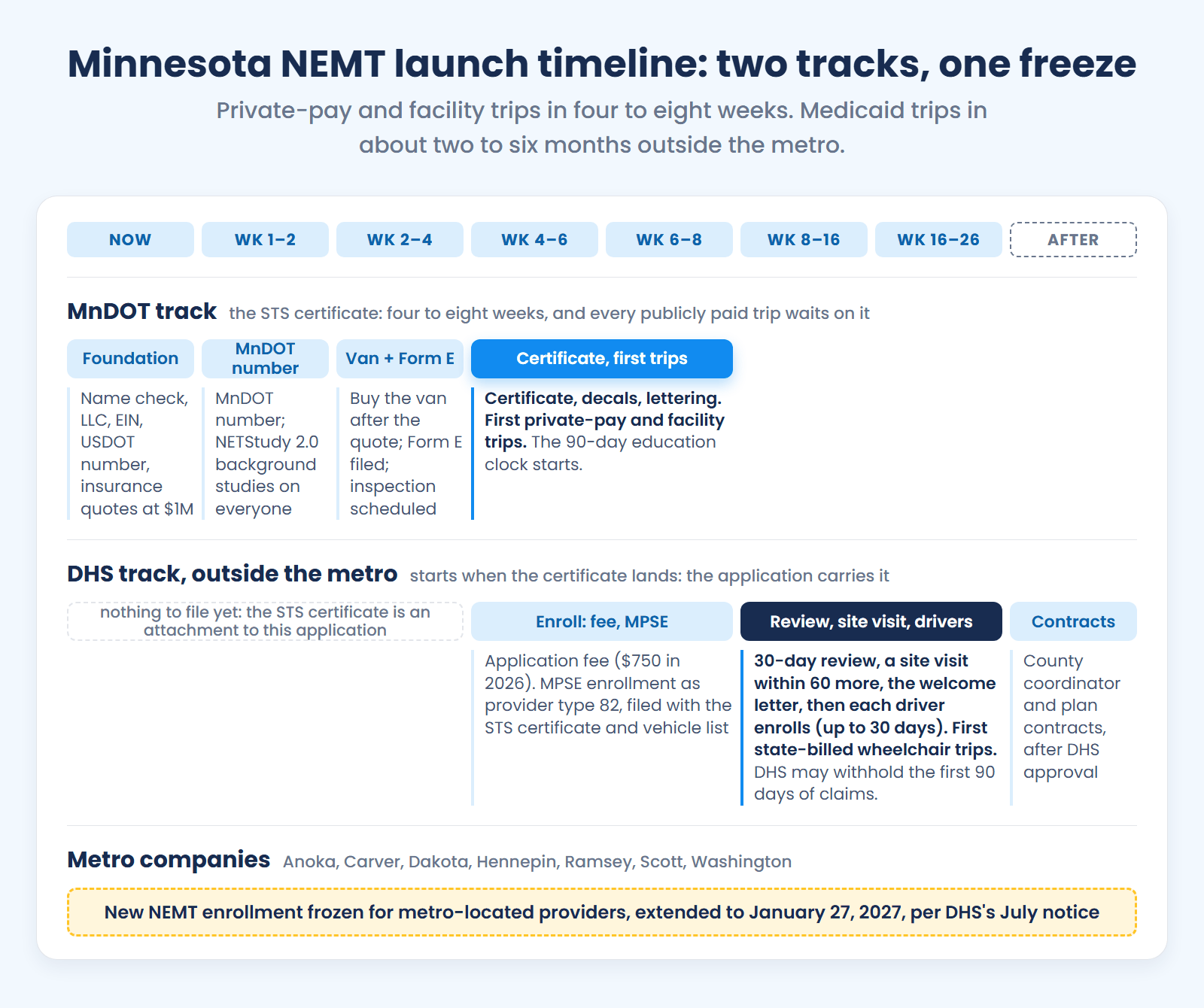
A new Minnesota NEMT company can carry its first private-pay and facility trips four to eight weeks after it files, and its first Medicaid trips in about two to six months outside the metro.
- Now. Check the name, file the LLC, get the EIN and USDOT number, and quote insurance at $1 million before you shop for a van.
- Weeks 1 to 4. File MnDOT’s business packet, start the background studies once the MnDOT number arrives, buy the van, and book the inspection after the insurer files the Form E [92][79].
- Weeks 4 to 8. The certificate, decals and lettering, then the first private-pay and facility trips. The 90-day education clock starts [16][17].
- Weeks 4 to 26, outside the metro. Once the certificate lands, pay the application fee ($750 in 2026), file in MPSE, get through DHS’s review and site visit, then enroll each driver. Bill your first state trips, knowing DHS may withhold the first 90 days of claims [12][20][21].
- After DHS approval. County and plan contracts, each with its own credentialing, about 60 days at Blue Cross [76].
Owners and managers applying on or after January 1, 2027 take DHS’s compliance training first [21].
The Twin Cities owner at the top of this guide was waiting “until they open.” For a metro company, that date is January 27, 2027, unless DHS extends it, and a company built on private pay and facilities is ready either way. Check DHS’s notice again in January.
Minnesota NEMT FAQ
Does Minnesota require a NEMT license?
Not by that name. MnDOT’s STS certificate is the operating authority for any company carrying elderly or disabled riders regularly with public money in the fare [65]. It costs $45 a van a year in decals, with no published application fee [15]. Medicaid work also needs DHS enrollment, so the certificate alone won’t bring state-paid trips.
Who is the NEMT broker in Minnesota?
No one, statewide. State law bars DHS from using a broker [26]. MTM Health coordinates the county lane for the metro consortium and the northeast, SmartLink covers Scott and Carver, and each health plan books its own members’ rides [39]. A future state administrator would change that, after six months’ notice to counties and plans [21].
What happened to UCare’s Medicaid plans?
They moved to Medica on October 1, 2026 and now run as Medica One Health Plan, so a transportation contract for those members goes through Medica [48]. Those riders book through Medica’s Provide-A-Ride [43]. UCare itself is in court-ordered rehabilitation, under a plan approved April 10, 2026 [50].
Is there a moratorium on new NEMT providers in Minnesota?
Yes, for companies located in the seven metro counties, through January 27, 2027. That notice was still current in DHS’s October 2026 provider news, and DHS can extend a moratorium [52]. Exceptions need written approval from CMS [54]. Companies located in the other 80 counties can enroll now, at high-risk screening.
Can I bill Minnesota Medicaid directly for NEMT rides?
Yes, for fee-for-service wheelchair, stretcher and protected trips, once DHS enrolls your company and each driver [2]. Ambulatory trips go through the county or its coordinator, and a plan member’s trip bills the plan. Every claim names the driver, and every trip needs the 14-element record kept five years [26][7].
How much does Minnesota Medicaid pay for a NEMT trip?
It pays by the rider’s assessed mode, not your vehicle [25]. As of October 2026 the schedule allows $19.80 plus $1.92 a loaded mile for wheelchair, $60 plus $2.71 for stretcher, and $75 plus $2.71 for protected transport [27][28]. The state’s rate doesn’t pay for the drive to the pickup.
Do NEMT drivers need a CDL in Minnesota?
No, not for a wheelchair van. A Class D license covers up to 15 passengers counting the driver and 26,000 pounds [90]. Every STS driver needs a fingerprint background study, a federal medical card and MnDOT-certified training within 45 days, and Medicaid trips add a DHS enrollment for each driver [22][23][26].
Can a NEMT company run stretcher van trips in Minnesota?
Yes, for riders not likely to need medical treatment on the way [96]. Medicaid pays $60 plus $2.71 a loaded mile, and drivers need two hours of stretcher training [27][23]. Treatment en route, or offering it, makes the trip an ambulance run, and running one without an ambulance license is a misdemeanor [112].
How much does it cost to start a NEMT business in Minnesota?
About $25,000 to $51,000 for one used wheelchair van and six months of fixed bills, if you drive it yourself. State fees are about $1,000 of that, most of it the $750 Medicaid application fee for 2026 [18]. Hire a driver at Minneapolis’s 2027 minimum wage and one van’s monthly burn runs about $5,500 to $6,500.
How long does it take to start a NEMT business in Minnesota?
Four to eight weeks to private-pay and facility trips, once background studies clear, the Form E is filed and MnDOT inspects the van [16]. Outside the metro, Medicaid trips take about two to six months: DHS allows 30 days, plus up to 60 for the site visit, then up to 30 per driver [12][20]. Inside the metro, Medicaid waits on the freeze.
Is Minnesota a good state to start a NEMT business in?
Outside the metro, yes, if you keep clean files: Medicaid paid for 6.9 million trips in 2024 [25]. Inside it, only if you can live on private pay and facilities until the freeze lifts. Private pay has room: one Winona County company’s posted wheelchair rate comes to $54.90 for ten miles, against the schedule’s non-rural $39.00 [33].
Key official sources
[1] Minnesota DHS, MHCP Provider News, July 14-27, 2026 issue, article published July 23, 2026: the NEMT enrollment moratorium extended to January 27, 2027 for providers located in the seven-county metro, with enrollment open elsewhere. https://mn.gov/dhs/assets/2026-07-14-mhcp-provider-news_tcm1053-761845.pdf
[2] Minnesota DHS Bulletin #25-21-10, “DHS Requests Biennial Health Care Access Plans for Calendar Years 2026 through 2027” (November 20, 2025): the seven modes defined, county-administered modes 1 to 4, state-administered modes 5 to 7 reimbursed directly to enrolled providers, county-lane providers paid by the county, the driver UMPI claim rule, coordinator fees, the MCO coverage rules. Its July 1, 2026 timing is superseded by Laws 2026, chapter 121. https://www.dhs.state.mn.us/main/groups/publications/documents/pub/mndhs-073659.pdf
[3] Minnesota Rules 8840.5450: restrictions on the name and description of the service. https://www.revisor.mn.gov/rules/8840.5450/
[4] Minnesota Secretary of State, Business Filing and Certification Fee Schedule (read October 22, 2026): LLC articles $155 online and $135 by mail, free annual renewal, assumed name $50 online. https://www.sos.mn.gov/business-liens/business-filing-and-certification-fee-schedule/
[5] Minnesota DHS form DHS-4016A, MHCP Organization Provider Enrollment Application (rev. 1-25): provider type 82 Medical Transportation and specialty 89 Special Transportation, no NPI requirement for the type, the application-fee rules, the attachment list. https://edocs.dhs.state.mn.us/lfserver/Public/DHS-4016A-ENG
[6] Minnesota DHS form DHS-4016, MHCP Individual Provider Enrollment Application (rev. 8-25): type DR Transportation Driver, the background study number field for NEMT drivers, group affiliation. https://edocs.dhs.state.mn.us/lfserver/Public/DHS-4016-ENG
[7] Minnesota DHS, MHCP Provider Manual, “Provider Requirements” (revised July 16, 2024; read October 22, 2026): exclusion-list screening, the five-year record-retention minimum, the 30-day change-of-ownership notice. https://www.dhs.state.mn.us/main/idcplg?IdcService=GET_DYNAMIC_CONVERSION&RevisionSelectionMethod=LatestReleased&dDocName=ID_008921
[8] MnDOT, Intrastate USDOT Number for STS Providers fact sheet (July 2025): no fee for an intrastate number. https://edocs-public.dot.state.mn.us/edocs_public/DMResultSet/download?docId=36493317
[9] MnDOT, Special Transportation Services, “Become a provider”: the steps, the naming restriction, the 90-day education requirement, and the Form E cost statement. https://www.dot.state.mn.us/cvo/sts/becomeaprovider.html
[10] Minnesota Statutes 245C.10, subdivision 13: background study fees for special transportation providers capped at $44 per study. https://www.revisor.mn.gov/statutes/cite/245C.10
[11] Minnesota DHS, Background Studies: the IDEMIA fingerprint and photo fee increase to $13.50 on March 30, 2026, paid separately from the NETStudy fee. https://mn.gov/dhs/background-studies/
[12] Minnesota DHS, MHCP Provider Manual, “Medical Transportation Enrollment Criteria and Forms” (revised July 1, 2026; read October 22, 2026): the STS certificate and MnDOT vehicle list, the screening fee, the site visit, 30 days for processing and up to 60 more for a DHS site visit, the provider agreements DHS-4138 and DHS-8355, who needs a background study. https://www.dhs.state.mn.us/main/idcplg?IdcService=GET_DYNAMIC_CONVERSION&RevisionSelectionMethod=LatestReleased&dDocName=ENROLL-82
[13] Minnesota Rules 8840.6000: STS insurance, the $500,000 combined single limit per vehicle, no-fault and uninsured coverage, Form E and Form K, suspension and the 45-day cure. https://www.revisor.mn.gov/rules/8840.6000/
[14] MTM Health, Minnesota Transportation Providers (read October 22, 2026): general and automobile liability policies of no less than $1,000,000 each, MTM as certificate holder and additional insured on both, workers’ compensation. https://www.mtm-inc.net/minnesota/transportation-providers/
[15] MnDOT, STS Vehicle Decal fact sheet (June 2025): $45 per decal, monthly invoicing, one-year validity. https://edocs-public.dot.state.mn.us/edocs_public/DMResultSet/download?docId=38907520
[16] Minnesota Rules 8840.5525: certificates issued or denied within 30 days of a complete application, one-year term, denial grounds. https://www.revisor.mn.gov/rules/8840.5525/
[17] Minnesota Rules 8840.5640: the 90-day initial provider education deadline and automatic cancellation. https://www.revisor.mn.gov/rules/8840.5640/
[18] Federal Register 2025-21877 (December 3, 2025): the $750.00 calendar year 2026 application fee for providers initially enrolling in Medicare or Medicaid, for applications submitted January 1 through December 31, 2026. https://www.govinfo.gov/content/pkg/FR-2025-12-03/html/2025-21877.htm
[19] Minnesota DHS, MHCP Provider News, January 27 to February 9, 2026 issue: NEMT designated a high-risk provider type, fingerprint studies for 5 percent owners, the unannounced site visit, the off-cycle revalidation, the January 8 freeze message (exceptions where capacity is needed, with written CMS approval), the October 29, 2025 pre-payment review of 14 high-risk services, under which some claims could be suspended up to 90 days, and the Provider Resource Center’s numbers. https://mn.gov/dhs/assets/2026-01-27-mhcp-provider-news_tcm1053-724398.pdf
[20] Minnesota DHS, MHCP Provider Manual, “Transportation Driver Enrollment Criteria and Forms” (revised January 5, 2026; read October 22, 2026): individual driver enrollment through the organization’s MPSE portfolio or by fax, the DHS-4611A agreement, the fingerprint-based NETStudy 2.0 study. https://www.dhs.state.mn.us/main/idcplg?IdcService=GET_DYNAMIC_CONVERSION&RevisionSelectionMethod=LatestReleased&dDocName=ENROLL-DR
[21] Laws of Minnesota 2026, chapter 121 (S.F. 4476, approved May 27, 2026): article 3, sections 27, 28, and 62 (the sunsets re-tied to implementation of the administrator, six months’ notice), sections 18 to 24 (new sections 256B.044 through 256B.0446: high-risk screening, the 90-day payment withhold, the enrollment moratorium, compliance training), and article 10 (electronic visit verification for NEMT from January 1, 2027 or federal approval). https://www.revisor.mn.gov/laws/2026/0/Session+Law/Chapter/121/
[22] Minnesota Rules 8840.5900: driver qualifications, age, license, driving record, the medical examiner’s certificate, annual record checks. https://www.revisor.mn.gov/rules/8840.5900/
[23] Minnesota Rules 8840.5910: driver and attendant training, the 45-day courses, passenger assistance hours, stretcher and child-restraint add-ons, the three-year refresher, proficiency testing and in-person instruction. https://www.revisor.mn.gov/rules/8840.5910/
[24] Minnesota Rules 8840.5925: vehicle equipment, stretcher securement, and vehicle identification on both sides. https://www.revisor.mn.gov/rules/8840.5925/
[25] Minnesota Department of Human Services, “Non-Emergency Medical Transportation (NEMT),” presentation to the House Fraud Prevention Committee (March 2, 2026; slides dated February 27, 2026): 2023 and 2024 trips, paid claims, provider and recipient counts, the 80 percent managed-care share, the no-load-miles rule, high-risk classification, the metro moratorium, investigation and suspension counts. https://www.house.mn.gov/comm/docs/V1YTkkW450ePEPE_hySgBg.pdf
[26] Minnesota Statutes 256B.0625 (2025 edition), subdivision 17 (NEMT definition, STS compliance and driver enrollment, the seven modes, the level-of-service rule, the 30- and 60-mile limits, rates, rural add-ons, fuel adjustment), 17b (documentation), 17c (nursing facility residents), 17e (five-year bar), 18b (broker prohibition), 18h (managed care), and 18i (the administrator). The page shows the 2025 text with July 1, 2026 expiration language that Laws 2026, chapter 121 replaced. https://www.revisor.mn.gov/statutes/cite/256B.0625
[27] Minnesota DHS, MHCP Fee Schedule, “current fee schedule as of 10/12/2026”: the NEMT base and mileage codes and amounts (mileage codes effective October 1, 2026), effective dates, and prior-authorization indicators. https://mn.gov/dhs/assets/mhcp-fee-schedule_tcm1053-294225.pdf
[28] Minnesota DHS, MHCP Provider Manual, “State-Administered Transportation Procedure Codes, Modifiers and Payment Rates” (revised October 6, 2026; read October 22, 2026): protected transport at $75.00 a trip and $2.71 a loaded mile from October 1, 2026, the wheelchair and stretcher codes and rates, the medical review agent’s line. https://www.dhs.state.mn.us/main/idcplg?IdcService=GET_DYNAMIC_CONVERSION&RevisionSelectionMethod=LatestReleased&dDocName=ID_016391
[29] Minnesota DHS, MHCP Provider Manual, “Nonemergency Medical Transportation (NEMT) Services” overview (revised April 7, 2025; read October 22, 2026): direct billing for state-administered modes, no MHCP billing for local-agency modes, the 837P format, mileage rounding, no-load and wait-time exclusions, the 30- and 60-mile limits. https://www.dhs.state.mn.us/main/idcplg?IdcService=GET_DYNAMIC_CONVERSION&RevisionSelectionMethod=LatestReleased&dDocName=id_008991
[30] South Country Health Alliance Provider Manual, chapter 27, Transportation Services (last updated February 27, 2026; read October 22, 2026): unloaded miles to the pickup and waiting past the first 60 minutes paid to contracted providers only; RideConnect schedules rides with providers. https://www.mnscha.org/wp-content/uploads/Ch27_02272026.pdf
[31] Centers for Medicare and Medicaid Services, Provider Data Catalog, nursing homes dataset (modified September 30, 2026), queried for Minnesota on October 22, 2026: 338 facilities and 24,057 certified beds. https://data.cms.gov/provider-data/dataset/4pq5-n9py
[32] Centers for Medicare and Medicaid Services, Provider Data Catalog, dialysis facilities dataset (modified June 16, 2026), queried for Minnesota on October 22, 2026: 113 facilities in 50 counties. https://data.cms.gov/provider-data/dataset/23ew-n7w9
[33] Sunset Mobility Inc., nonemergency medical transportation in Winona County, Minnesota: posted rates, $30 pickup plus $2.49 a mile for wheelchair transport (as seen October 18, 2026). https://sunsetmobilityinc.com/services/non-emergency-medical-transportation-winona-county-mn/
[34] U.S. Census Bureau, Vintage 2024 county population estimates by age and sex for Minnesota: statewide and county 65-and-over counts and shares as of July 1, 2024, and the 2020 to 2024 change. https://www2.census.gov/programs-surveys/popest/datasets/2020-2024/counties/asrh/cc-est2024-agesex-27.csv
[35] Centers for Medicare and Medicaid Services, Minnesota’s approved CADI 1915(c) waiver application (MN.0166.R08, effective October 1, 2025) and Elderly Waiver application (MN.0025.R09.04, effective January 1, 2026): the transportation service definition, provider qualifications including MnDOT STS certification, and market-rate pricing. https://www.medicaid.gov/medicaid/section-1115-demo/demonstration-and-waiver-list/82181
[36] Minnesota Statutes 256B.4912: home and community-based services provider requirements, applicant training, and subdivision 13 on waiver transportation documentation and its separation from medical transportation. https://www.revisor.mn.gov/statutes/cite/256B.4912
[37] Minnesota DHS, DHS-3945, “Long-Term Services and Supports Service Rate Limits Effective October 1, 2026”: the waiver transportation one-way trip and mileage rate limits by program. https://edocs.dhs.state.mn.us/lfserver/Public/DHS-3945-ENG
[38] MTM Health, Minnesota Non-Emergency Medical Transportation (read October 22, 2026): the Metro County Consortium contract statement and the member line. https://www.mtm-inc.net/minnesota/
[39] Minnesota DHS, MHCP Provider Manual, “Local County or Tribal Agency Nonemergency Medical Transportation (NEMT) Services” (revised July 7, 2025; read October 22, 2026): the Hennepin-hosted and St. Louis County-hosted coordination contracts and their counties, SmartLink for Scott and Carver, contracting through MTM-MNET, SmartLink or the county, and no MHCP billing by local-agency providers. https://www.dhs.state.mn.us/main/idcplg?IdcService=GET_DYNAMIC_CONVERSION&RevisionSelectionMethod=LatestReleased&dDocName=dhs16_141019
[40] Scott County, Non-Emergency Medical Assistance (read October 22, 2026): rides and mileage reimbursement for eligible Scott and Carver County residents through the two counties’ shared mobility office, the coordinator DHS’s manual calls SmartLink. https://www.scottcountymn.gov/553/Non-Emergency-Medical-Assistance
[41] Blue Cross and Blue Shield of Minnesota, BlueRide member page (DHS approved November 19, 2024; read October 22, 2026): the ride line, the online form for requests five business days or more ahead, phone requests. https://www.bluecrossmn.com/our-plans/medical-assistance-medicaid/medical-assistance-resources/blueride-transportation
[42] HealthPartners, RideCare medical transportation (read October 22, 2026): the ride line, three to five days’ notice for scheduled appointments and five to seven with mobility assistance, the 30- and 60-mile scope. https://www.healthpartners.com/insurance/members/benefits-discounts/ridecare-medical-transportation/
[43] Medica, Provide-A-Ride for Minnesota Health Care Programs members (last updated November 2025; read October 22, 2026): call Member Services at least five days before the appointment; the 30- and 60-mile limits; a Medica One Health Plans line. https://www.medica.com/find-care/select-your-medicaid-plan/resources/provide-a-ride
[44] Hennepin Health, “Get a ride” (DHS approved September 24, 2020; read October 22, 2026): Member Services numbers, three days’ notice, the authorization rules for taxi and specialized transport. https://www.hennepinhealth.org/members/Get-a-ride
[45] PrimeWest Health, Administered NEMT Services (updated December 8, 2025; read October 22, 2026): modes 2 through 7, the Transportation Contact Center, rides requested at least two business days ahead. https://www.primewest.org/pwh-administered-nemt
[46] South Country Health Alliance, RideConnect (last updated January 16, 2026; read October 22, 2026): the member line, at least three business days’ notice, pre-authorization for assisted trips. https://www.mnscha.org/members/member-services/rideconnect/
[47] IMCare Provider Manual, Transportation Services (revised September 12, 2024; read October 22, 2026): members call IMCare Member Services, up to five days’ notice for public transportation and at least three days for other modes. https://www.itascacountymn.gov/DocumentCenter/View/735/Transportation-Services-PDFUpdated-091224
[48] Medica, “Medicaid member migration” provider page (read October 22, 2026): UCare’s Medicaid members moved to Medica on October 1, 2026 as Medica One Health Plan (PMAP, MinnesotaCare, MSC+ and SNBC), payer ID 71890; a Certificate of Need still required for special transportation. https://partner.medica.com/providers/ucare-member-transition/medicaid-member-migration
[49] Minnesota DHS, Default Enrollment Process Technical Specifications, effective October 1, 2026: “there is a name change for UCare to Medica One Health Plan”; the PMAP, MinnesotaCare, MSC+ and SNBC plan charts. https://mn.gov/dhs/assets/default-enrollment-process-technical-specifications_tcm1053-557574.pdf
[50] UCare in Rehabilitation, the court-appointed Rehabilitator’s site (updated October 2026; read October 22, 2026): rehabilitation ordered December 17, 2025; the rehabilitation plan approved April 10, 2026. https://ucare-inreceivership.com/
[51] Laws of Minnesota 2025, First Special Session, chapter 3, article 8, sections 13, 14, and 43 (approved June 14, 2025): the subdivision 17 sunsets, new subdivision 18i, the repeal of 18b, 18e, and 18h, and the sunset of the competitive-bidding bar on special transportation. https://www.revisor.mn.gov/laws/2025/1/Session+Law/Chapter/3/
[52] Minnesota DHS, MHCP Provider News, October 6-19, 2026 issue: the July 23, 2026 metro NEMT moratorium notice, still current; the July 10 extension of the moratorium for 12 of 14 high-risk services through January 27, 2027; the Provider Resource Center’s numbers. https://mn.gov/dhs/assets/2026-10-06-mhcp-provider-news_tcm1053-772195.pdf
[53] Minnesota DHS, MHCP Provider Manual, “Latest Manual Revisions” (revised October 20, 2026; read October 22, 2026): the October 1, 2026 fuel adjustments, the July 31, 2026 referring-provider entry on the county-lane claim page, and UCare’s name change to Medica One Health Plan effective October 1, 2026. https://www.dhs.state.mn.us/main/idcplg?IdcService=GET_DYNAMIC_CONVERSION&RevisionSelectionMethod=LatestReleased&dDocName=dhs16_137531
[54] Minnesota DHS news release, “Minnesota Department of Human Services freezes provider enrollment for 13 Medicaid services” (January 30, 2026): the January 27, 2026 freeze, the category list including nonemergency medical transportation services, CMS’s direction, the exception rule and existing enrolled providers’ new locations. https://content.govdelivery.com/accounts/MNDHS/bulletins/406e446
[55] Centers for Medicare and Medicaid Services, Medicaid Provider Enrollment Compendium (last updated November 17, 2025): 42 CFR 438.602(b)(1) requires states to screen and enroll all network providers of Medicaid managed care plans. https://www.medicaid.gov/medicaid/program-integrity/downloads/mpec.pdf
[56] Minnesota DHS, MHCP Provider News, July 28 to August 10, 2026 issue: the July 31, 2026 article requiring a transportation company’s NPI or UMPI as the referring provider on NEMT claims a county, tribal agency or coordinator submits, from August 1, 2026, on claims that carry an individual driver’s UMPI as the rendering provider. https://mn.gov/dhs/assets/2026-07-28-mhcp-provider-news_tcm1053-763207.pdf
[57] Minnesota DHS, MHCP Provider Manual, “Enrollment with Minnesota Health Care Programs (MHCP)” (revised July 6, 2026; read October 22, 2026): requests completed within 30 days of receipt, the nonrefundable application fee paid before applying, 60 days to answer a request for more information, approval once site visits and background checks are done. https://www.dhs.state.mn.us/main/idcplg?IdcService=GET_DYNAMIC_CONVERSION&RevisionSelectionMethod=LatestReleased&dDocName=id_000090
[58] Minnesota DHS news release (June 4, 2026): Minnesota Revalidate results, 2,061 providers revalidated and 3,411 disenrollment notices. https://content.govdelivery.com/accounts/MNDHS/bulletins/41a6cae
[59] Georgetown University Center for Children and Families, “Revalidation of High-Risk Medicaid Providers: Early Lessons from Minnesota” (July 8, 2026): the breakdown of the 3,411 disenrollment notices. https://ccf.georgetown.edu/2026/07/08/revalidation-of-high-risk-medicaid-providers-early-lessons-from-minnesota/
[60] Georgetown University Center for Children and Families, “Minnesota Medicaid fraud timeline” (updated; read October 22, 2026): the dated sequence of corrective action plans, CMS’s deferrals, the lawsuit, and the court-ordered stay to January 4, 2027 on three deferrals totaling $533.2 million. https://ccf.georgetown.edu/2026/04/13/minnesota-medicaid-fraud-timeline/
[61] Minnesota House Research Department, “Electronic Visit Verification” short subject (August 2026): EVV expanded to more Medicaid services in July 2026, nonemergency medical transportation among the services it applies to, implementation dates set by the commissioner. https://www.house.mn.gov/hrd/pubs/ss/ssevv.pdf
[62] Acentra Health, Minnesota MHCP transportation page (read October 22, 2026): level-of-service requests through the Atrezzo portal or by phone, turnaround of 10 days for pended cases and 72 hours for expedited cases since January 1, 2026, the DHS-6715 protected-transport form. https://mhcp.acentra.com/transportation/
[63] Minnesota DHS, MHCP Provider Manual, “State-Administered NEMT” (revised July 7, 2025; read October 22, 2026): nursing facility residents’ automatic qualification for non-stretcher trips, the stretcher certification rule, attendant billing. https://www.dhs.state.mn.us/main/idcplg?IdcService=GET_DYNAMIC_CONVERSION&RevisionSelectionMethod=LatestReleased&dDocName=dhs16_141021
[64] Minnesota DHS, MHCP Payment and Claim Cut-off Calendars, DHS-3947J-ENG 1-25 (the 2025 calendars, still the edition at this address on October 22, 2026): the two-week claim cycle, Thursday cut-offs, Wednesday EFT, remittances every other Friday. https://edocs.dhs.state.mn.us/lfserver/Public/DHS-3947J-ENG
[65] Minnesota Statutes 174.30: STS operating standards, applicability and exemptions, the $45 decal, the naming carve-out, the preemption of other state and local permits, penalties, and the background-study list including dispatchers and billers. https://www.revisor.mn.gov/statutes/cite/174.30
[66] Minnesota Rules 8840.5400: no special transportation service without a current certificate of compliance. https://www.revisor.mn.gov/rules/8840.5400/
[67] Minnesota House of Representatives, Health Finance and Policy Committee, minutes of the February 24, 2025 meeting: H.F. 36 moved before the committee and laid over. https://www.house.mn.gov/Committees/minutes/94011/101075
[68] Minnesota Revisor, H.F. 36 (2025) status in the House: introduced February 10, 2025, referred to Health Finance and Policy, no further action. https://www.revisor.mn.gov/bills/94/2025/0/HF/36/
[69] Minnesota Rules 8840.5100: STS definitions, including “regular basis” and “grants or other financial assistance.” https://www.revisor.mn.gov/rules/8840.5100/
[70] Minnesota Statutes 174.315: penalties of up to $10,000 for transporting a passenger who might reasonably require an ambulance, and revocation on a third violation in three years. https://www.revisor.mn.gov/statutes/cite/174.315
[71] Minneapolis Code of Ordinances, section 341.335, medical contract transport (1995; read October 22, 2026): prearranged, flat-fare service between a patient’s home and a contracting medical facility in vehicles for fewer than ten passengers, and the permit it requires. https://library.municode.com/mn/minneapolis/codes/code_of_ordinances?nodeId=COOR_TIT13LIBURE_CH341TA
[72] City of Minneapolis, License fees (the 2026 fee schedule and the proposed 2027 schedule, read October 22, 2026): “Taxi Vehicle, Medical Transport Carrier” at $1,050 in 2026, with no change proposed for 2027. https://www.minneapolismn.gov/business-services/licenses-permits-inspections/business-licenses/information/fees-fines/license-fees/
[73] Metropolitan Airports Commission, Ordinance 122, Commercial Vehicles (adopted October 17, 2016, effective January 1, 2017): permit and per-trip fees, the definition of commercial vehicle, and the small passenger vehicle restriction. https://metroairports.org/documents/ordinances/ordinance-122
[74] Minnesota Statutes 174.29: the definition of special transportation service, including taxis, and its incorporation of Medicaid NEMT. https://www.revisor.mn.gov/statutes/cite/174.29
[75] City of Saint Paul, Department of Safety and Inspections, business licenses and permits fee list (page edited October 7, 2026): taxicab driver $51, taxicab vehicle $469, and no medical transportation category. https://www.stpaul.gov/departments/safety-inspections/open-operate-expand-business/business-licenses-and-permits-1
[76] Blue Cross and Blue Shield of Minnesota, “Contracting for transportation providers” (read October 22, 2026): a contract request form for each type of service, the STS certificate for each vehicle, NETStudy proof, $1 million combined single limit auto liability, about 60 days for an approved request, no guarantee of a contract. https://www.bluecrossmn.com/providers/network-participation/join-our-network/contracting-transportation-providers
[77] MnDOT, STS Insurance fact sheet (June 2025): the $500,000 minimum, the Form E signed by the insurer, suspension and cancellation timing. https://edocs-public.dot.state.mn.us/edocs_public/DMResultSet/download?docId=36491510
[78] Amwins, Paratransit Program (page current May 26, 2026; read October 22, 2026): NEMT and wheelchair vans, $1 million auto liability, admitted in Minnesota, three years in business, minimum five units. https://www.amwins.com/products/paratransit-program-amwins
[79] Minnesota Rules 8840.5500: the certificate application, the USDOT number, the Form E, the workers’ compensation statement, and ten-day change notices. https://www.revisor.mn.gov/rules/8840.5500/
[80] Minnesota Statutes 176.181: compulsory workers’ compensation insurance, the penalty of up to $1,000 per employee per week, and the gross misdemeanor. https://www.revisor.mn.gov/statutes/cite/176.181
[81] Minnesota Statutes 176.041, subdivision 1: the sole proprietor and LLC manager exclusions. https://www.revisor.mn.gov/statutes/cite/176.041
[82] Minnesota Statutes 181.722: misclassification of employees, the penalties, and the test. https://www.revisor.mn.gov/statutes/cite/181.722
[83] Unemployment Insurance Minnesota, Paid Leave small employer premium rate: 0.66 percent for employers with 30 or fewer employees. https://ui.mn.gov/employers/paid-leave/small-employer-premiums.jsp
[84] Minnesota Department of Employment and Economic Development, “Paid Leave Premium Rate Unchanged for 2027” (July 31, 2026): 0.88 percent of covered wages for 2027, with up to 0.44 percent collectible from employees. https://content.govdelivery.com/accounts/MNDEED/bulletins/422fdf7
[85] Minnesota Department of Labor and Industry, “New minimum-wage rates, changes to meal and rest break laws take effect Jan. 1, 2026” (December 17, 2025): $11.41, the training wage, the rest and meal break rules. https://www.dli.mn.gov/news/new-minimum-wage-rates-changes-meal-and-rest-break-laws-take-effect-jan-1-2026
[86] Minnesota Department of Labor and Industry, “Minimum-wage rate adjusted for inflation as of Jan. 1, 2027” (August 19, 2026): $11.87 an hour statewide from January 1, 2027. https://dli.mn.gov/news/minimum-wage-rate-adjusted-inflation-jan-1-2027
[87] City of Minneapolis, Minimum Wage (read October 22, 2026): $16.37 in 2026 and $17.02 from January 1, 2027, for every employer. https://minimumwage.minneapolismn.gov/
[88] City of Saint Paul, Minimum Wage (page edited August 31, 2026; read October 22, 2026): $14.25 for businesses with five or fewer employees until July 1, 2027, then $15.00; $16.37 for 6 to 100 employees until July 1, 2027, then $17.02; $17.02 for larger businesses from January 1, 2027. https://www.stpaul.gov/departments/human-rights-equal-economic-opportunity/labor-standards-enforcement-and-education/minimum-wage
[89] Minnesota Workers’ Compensation Assigned Risk Plan, rates effective January 1, 2026: class codes 7370, 7380, and 7382. https://www.mwcarp.org/_DOWNLOAD/2025-1234.pdf
[90] Minnesota Statutes 171.02, subdivision 2: the license classes, and the Class D limits of 26,000 pounds and 15 passengers including the driver. https://www.revisor.mn.gov/statutes/cite/171.02
[91] MnDOT, STS Driver’s License and Driving Records general information (June 2026): a CDL with passenger endorsement at 16 or more passengers including the driver. https://edocs-public.dot.state.mn.us/edocs_public/DMResultSet/download?docId=38907409
[92] MnDOT, NETStudy 2.0 Background Studies general information for STS providers (October 2018): who needs a study, the MnDOT number prerequisite, timing, the 180-day rule, and its outdated fee figures. https://www.dot.state.mn.us/cvo/sts/pdf/netstudy.pdf
[93] PrimeWest Health, Transportation Providers, Join PrimeWest Network: MnDOT certification, DHS enrollment, protected-transport training. https://www.primewest.org/join-our-network/eligible-providers/transportation
[94] Minnesota Rules 8840.6100: records, trip records, attendant files, and retention periods. https://www.revisor.mn.gov/rules/8840.6100/
[95] Minnesota Statutes 299A.12, 299A.14, and 299A.17: wheelchair securement devices, inspection within a month of installation and annually, and the misdemeanor. https://www.revisor.mn.gov/statutes/cite/299A.14
[96] Minnesota Statutes 144E.001, subdivision 3: the definition of ambulance service, including the stretcher clause. https://www.revisor.mn.gov/statutes/cite/144E.001
[97] Minnesota DHS form DHS-6715, MHCP Protected Transport Level-of-Service Assessment (rev. 6-25): crisis-team certification, single trip and single date. https://edocs.dhs.state.mn.us/lfserver/Public/DHS-6715-ENG
[98] Minnesota DHS, MHCP Provider Manual, “Protected Transportation Services” (revised April 18, 2025; read October 22, 2026): the driver-plus-attendant rule and its emergency-department exception, the six-hour training options, hospital certification on DHS-6715. https://www.dhs.state.mn.us/main/idcplg?IdcService=GET_DYNAMIC_CONVERSION&RevisionSelectionMethod=LatestReleased&dDocName=dhs-288176
[99] MTM Health, Service Providers: how a transportation company applies to join MTM’s network. https://www.mtm-inc.net/service-providers/
[100] Mayo Clinic in Rochester, Community Health Needs Assessment 2025: 2024 hospital admissions and patient origin within and beyond 120 miles. https://static1.squarespace.com/static/644aa122716271579b019f2c/t/6942c8951cdbae5a164f1e1c/1765984405969/Rochester+CHNA+2025+Final+mc4776-05.pdf
[101] U.S. Census Bureau, Vintage 2024 subcounty population estimates: Rochester, Duluth, and St. Cloud populations as of July 1, 2024. https://www2.census.gov/programs-surveys/popest/datasets/2020-2024/cities/totals/sub-est2024.csv
[102] Minnesota Statutes 322C.0113 and 5.36: an LLC must have a registered office and may have a registered agent. https://www.revisor.mn.gov/statutes/cite/322C.0113
[103] Minnesota Statutes 333.01: assumed name certificates and newspaper publication in two successive issues. https://www.revisor.mn.gov/statutes/cite/333.01
[104] Rollx Vans, Savage, Minnesota, used wheelchair vans for sale: listings and prices as seen October 22, 2026. https://www.rollxvans.com/used-handicap-vans-for-sale/
[105] MobilityWorks, Roseville, Minnesota, wheelchair vans for sale: listings and prices as seen October 22, 2026. https://www.mobilityworks.com/wheelchair-vans-for-sale/minnesota/
[106] MobilityWorks Commercial, 2026 Ford Transit T350 wheelchair conversion (read October 22, 2026): $79,999 plus tax after a $1,000 mobility rebate and a $1,700 government price concession, in an offer valid October 1 to December 31, 2026. https://commercial.mobilityworks.com/ford-transit-commercial-van/
[107] Minnesota Statutes 168.013, subdivision 1a: the registration tax formula and the cap for a used vehicle previously registered in Minnesota. https://www.revisor.mn.gov/statutes/cite/168.013
[108] Minnesota Statutes 297B.01, subdivision 14, and 297B.02: the 6.875 percent motor vehicle sales tax and the exclusion for accessibility modifications. https://www.revisor.mn.gov/statutes/cite/297B.01
[109] Minnesota Statutes 116M.18: the Minnesota Emerging Entrepreneur Program loan sizes, eligibility, matching, rate cap, and forgiveness. https://www.revisor.mn.gov/statutes/cite/116M.18
[110] African Development Center, Start a Business: microloans up to $50,000, business loans up to $350,000, vehicle and equipment financing, service area. https://www.adcminnesota.org/services-programs/start-business
[111] WomenVenture, Lending (read October 22, 2026): loans up to $100,000, no application fee, eligibility for any business that can show it can be profitable. https://www.womenventure.org/services/lending/
[112] Minnesota Statutes 144E.33 and 609.03: a misdemeanor for violating the ambulance chapter, and the misdemeanor maximum. https://www.revisor.mn.gov/statutes/cite/144E.33
Last checked against the sources above in October 2026. Minnesota’s NEMT rules, rates and enrollment status change, so check the primary sources before you act, and treat this guide as education, not legal advice.
About the author
James O'Donnell cofounded Duet and leads its sales, partnerships, and growth services. He talks with NEMT operators every week, hosts the NEMT Growth podcast, and answers Duet's sales line himself. More about Duet's founders →
Starting in a nearby state?
Want more trips and less busywork?
See how Duet runs and grows NEMT businesses in a 30-minute demo.